Showing posts with label # Belarus. Show all posts

Friday, March 8, 2019

Postcrossing in Belarus

Postcrossing has become a favourite postal activity across the globe in the last few years , and more so in Europe. A postcrosser sends a postcard to a random person across the globe , and that person sends another postcard to a different person. So when one sends a postcard , he receives a postcard from another person . 

Postcrossing has helped in reviving postal departments in many countries, and has also helped connect with people across the world in the more traditional way of letter writing ! Many countries have issued stamps and postmarks honouring Postcrossing. Postcrossers also have Postcrossing meet-ups , and many post office Issue special postmarks for the occasion ! 

Belarus has a permanent pictorial cancellation for Postcrossing in 18 of its postoffices ! 

1. Minsk-1 ☑️
2. Minsk central post office ☑️
3. Dzerzhynsk-2
4. Brest-10 ☑️
5. Pinsk-15 ☑️
6. Berioza-4
7. Baranovichi-8 ☑️
8. Gomel-17
9. Gomel-48
10. Vitebsk-15
11. Magilev-30 ☑️
12. Grodno-25
13. Grodno-27
14. Lida-11
15. Smargon-2
16. Slonim-9
17. Novogrudok-4
18. Volkovisk-6

The number after name of city - it's № of post office where the postmark is available 

Watch this space for the postmarks from these postoffices ! 

Minsk- 1


Baranovichski - 8


Pinsk - 15
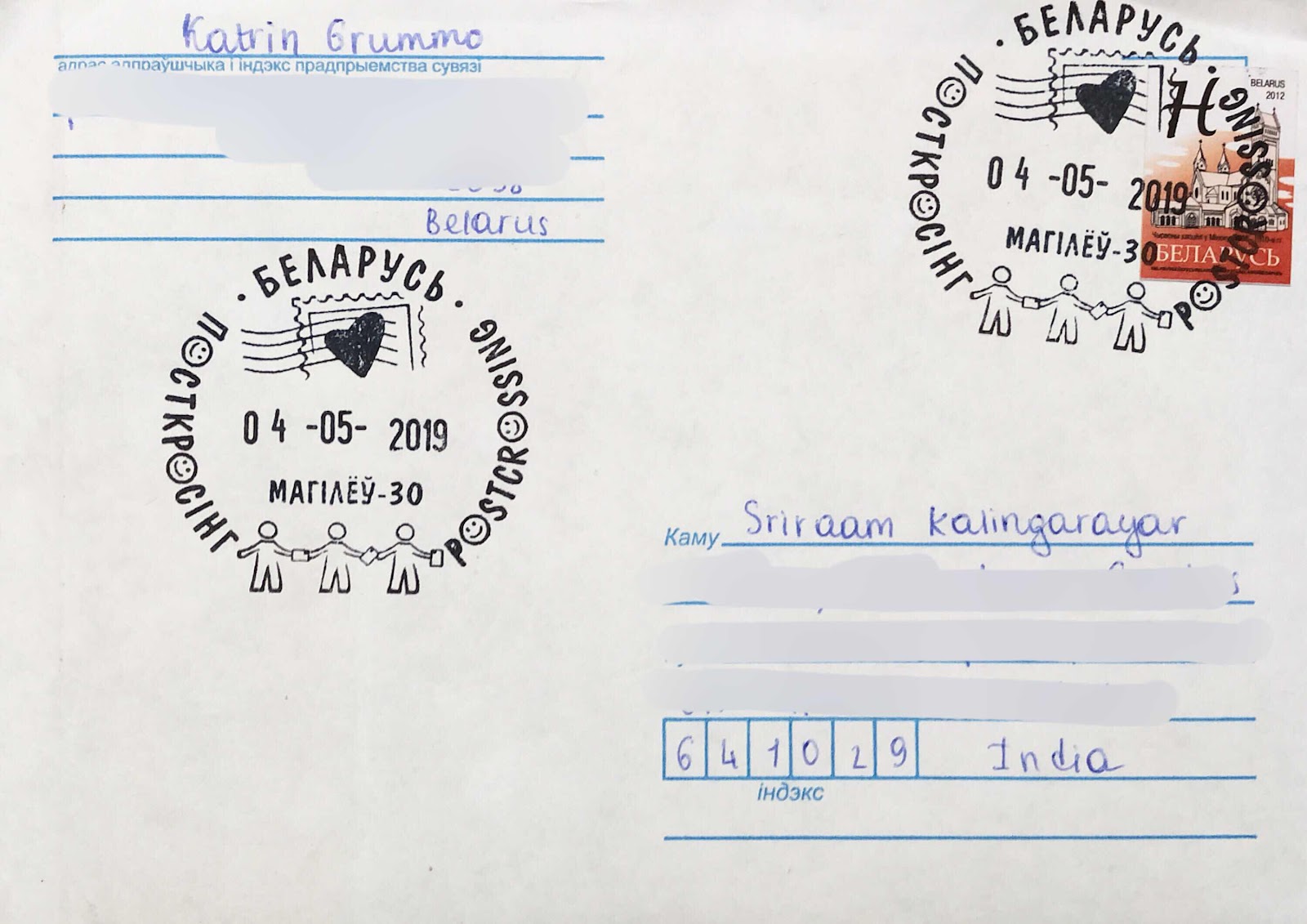


Mogilev- 30
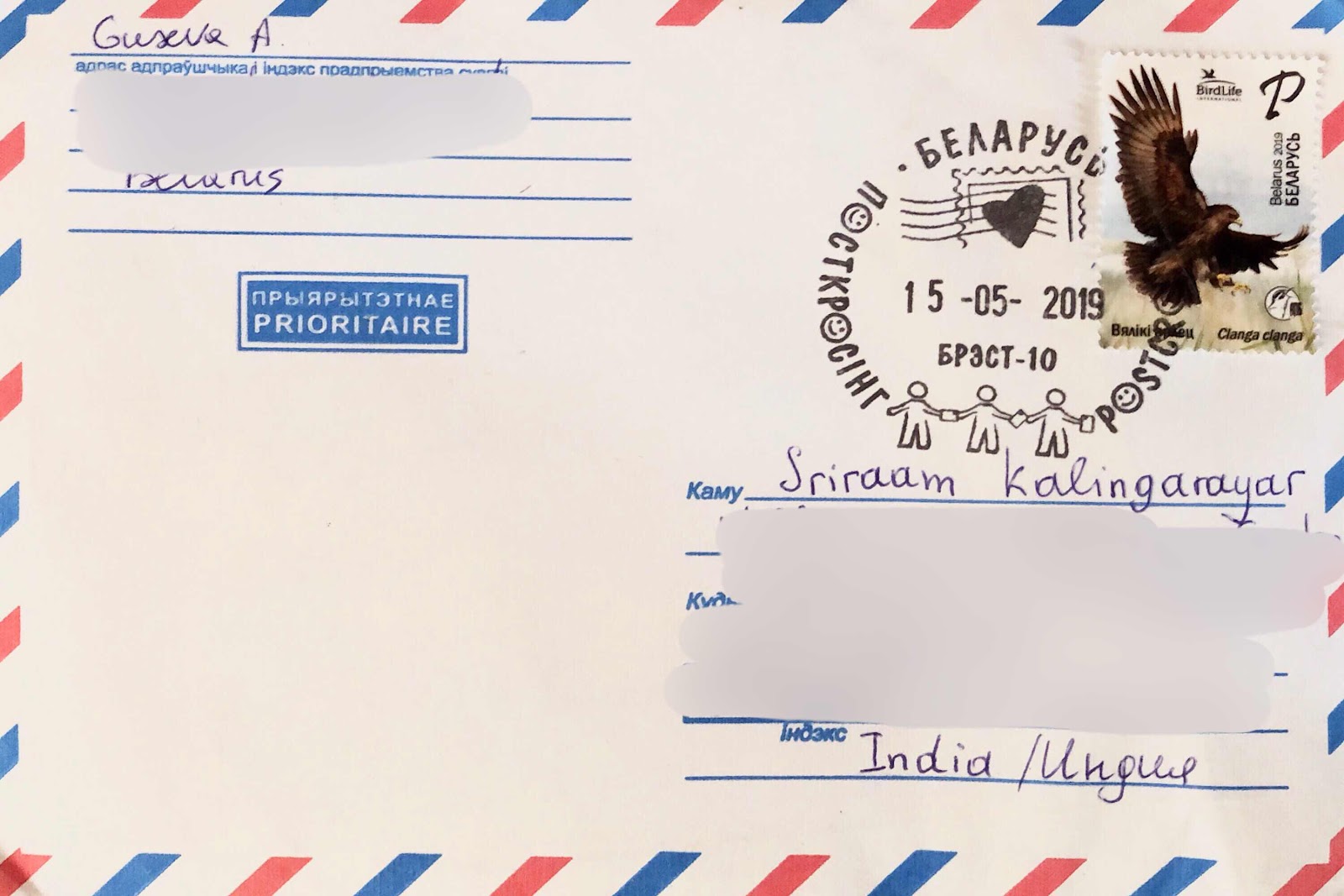
Brest - 10
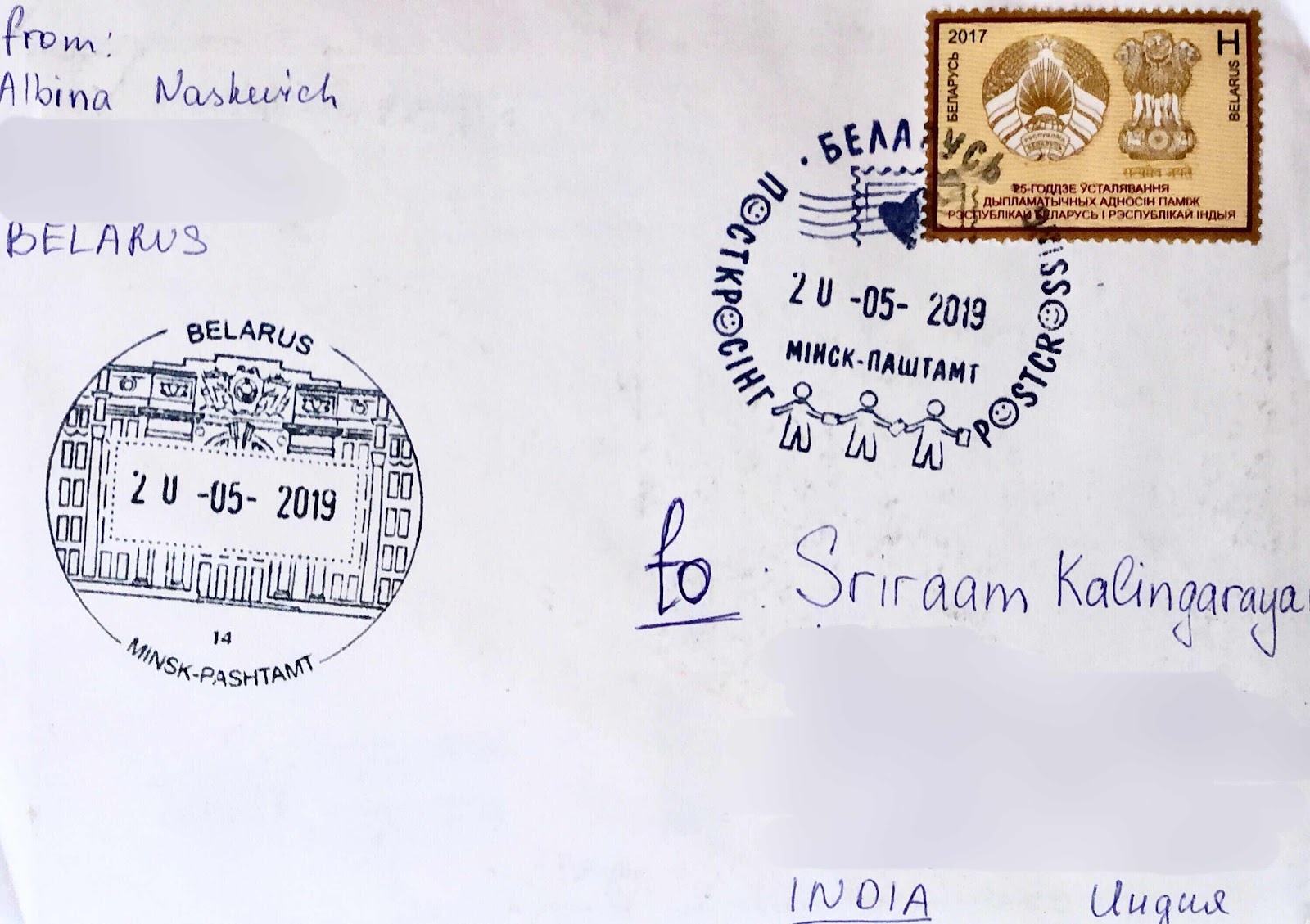

Minsk - Central Post Office 

Thursday, February 21, 2019

Postcrossing in Belarus


A Postcrossing meetup card from Belarus with the postacrossing stamp and a special cancel! 


The stamp was issued in 2014 with the words Happy Postcrossing in English and Belarusian ! 
The postage rate is indicated by N 

The Belarus Post offers permanent special cancelation for postcrossing in 18 postoffices across the country. The one on the postcard is from Minsk post office No. 1 

I am hoping to collect the other 17 postmarks too - and 3 more are already on their way ! So stay tuned to this space to see the updates ;) 

Thanks Yuliya for this postcard :) 


Saturday, February 16, 2019

Belarusian national costume


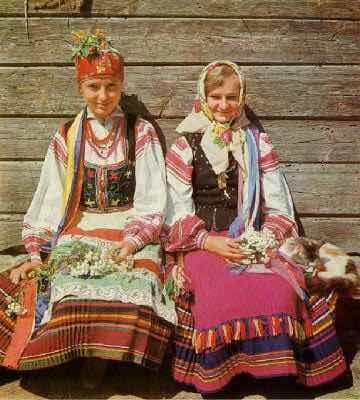
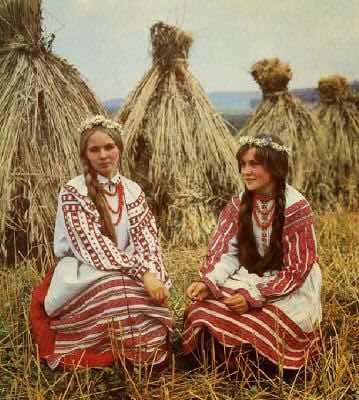
Covers from Belarus with 2012 stamps on traditional costume of Belarus 🇧🇾 


Though Belarus is not such a big country there are 22 variants of the national costume. Regional differences are mainly in the small details of the costume and in motives and subjects of ornament.


Garments for the women include a chemise (kashulya) made of homespun linen; a heavy pleated checked or striped woven wool or linen skirt (spadnitsa or andarak); a linen homespun apron, and a waistcoat. Sleeves, shoulder insets, collar and bosom have embroidered patterns in red and black yarn, the composition of ornamenting depending on the region where the set belongs. The apron has colouring and ornamenting similar to those of the gown. The waistcoat being a festive attire was made of industrially manufactured textiles such as silk and velvet. The obligatory part of every costume is multi-color belt with pompons, tassels or fringes.

On their head young girls would wear coronets and narrow head-towels (skindochka), while married women wore bonnets and hoods. Still more women prefered namitkas head-towels which could be skilfully draped in many ways. Strings of beads complete the costume.

Men's costume include a linen shirt worn over the trousers, a waist-band and a pair of narrow trousers. The shirt has a bosom cut and a turn down collar. In certain regions a waist coat (kamiselka) is worn over it. A leather hand-bag called calita is a part of the garment too. The head-dress is a simple straw hat.
Symbolism of the costume's embroidery is ancient. White, the colour of homespun linen, is the colour of heaven; red is the colour of the sun and earth and is protective of life; black is the colour of the underworld and spiritual life.

The costume's different parts represent three spheres: neck, shoulders and sleeves represent the higher world; the waist - the earth; and the hem - the underworld. Different shapes of ornament are supposed to ward off evil. For example, the hands of working women were protected from spells and bad spirits by decoration of their sleeves with the bright red rhombic ornaments that is believed to have magical powers. 

Thanks Alexander for these covers ! 


Monday, January 28, 2019

Bridges of Belarus


A cover from Belarus with the Europa 2018 stamps. 


The automobile bridge across the river Disna in Disna town is a unique arched bridge with a wooden coating on a metal and stone base.It is considered to be the oldest automobile bridge in Belarus— it is used for 100 years. 

Asmall pedestrian bridge connects the Trinity suburb with an artificial island on the river Svisloch inMinsk. On the island there is a memorial complex “Island of Courage and Sorrow”, dedicated to the Belarusian soldiers who died in Afghanistanin 1979-1989.

Sunday, January 20, 2019

Happy New Year Belarus


Happy new year from Belarus !! 
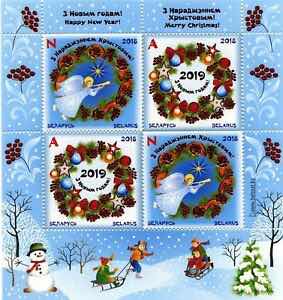
Belarus issued a beautiful stamp for new year wishes 2019 ! 

Thanks Nastassia for this cover and a very happy new year to you too :) 


Friday, October 26, 2018

Birds and the Belarusian forest


A stunning cover from Belarus ! 

Naliboki Pushcha 

Naliboki Pushcha is one of the largest forests of Belarus. It is located in the basins of the right tributaries of the Neman — Berezina and Ussa, extending to Oshmyany ridges in the north and to the Minsk Upland in the east.


Naliboki Pushcha is of great importance as a unique object of biological and landscape diversity. Now on its territory there are 30 species of plants, 12 species of invertebrates, 3 species of fish, 3 species of amphibians and reptiles, 29 species of birds and 4 species of mammals listed in the Red Book of Belarus and the International Red Data Book.


The Naliboki massacre was the 8 May 1943 mass killing of 129 Poles, including women and children, by Soviet partisans in the small town of Naliboki in German-occupied Poland (the town is now in Belarus)


Date of issue : 24-11-2014

Design : Anna Malash 


Common Cuckoo 


Bird of the year - common cuckoo

This is the famous bird of Europe whose voice is imitated by cuckoo clocks (and whose call, coo-coo, gave the name to the entire cuckoo family). It is well known as a brood parasite: females lay their eggs in the nests of smaller birds, and their hapless "hosts" raise only young cuckoos. A common migratory bird across most of Europe and Asia, it regularly strays to the western Alaskan islands in late spring and early summer.

Date of issue - 11-03-2014

Designer -  Alexander Mityanin 


Thanks Nastassia for the cover - and also the postcard and the story about a bench ! 

Tuesday, August 14, 2018

A blue bouquet from Belarus


A surprise cover from Belarus. Thanks Nastassia! 

The cover and the postcards inside , full of cornflowers with striking blue and green :) I found a letter inside where she had written so much about these beautiful flowers and their significance in Belarus culture ! I was surprised to know that they come in varying colours from Snow White to deep purple - nevertheless the blue ones being the lucky charms and also loaded with medicinal qualities ! 

The cover also has another Belarusian national symbol - the national bird - the white stork ! The cancellation shows a white stork in flight with the words - Welcome to Belarus ! 


The stamps - Racoon dog - a definitive issue of 2014 on wild animals with face value - A. 
Racoon dogs are candid species native of the Far East but introduced in the Early USSR countries during 1930s and have now become widespread in countries like Belarus and Ukraine. 

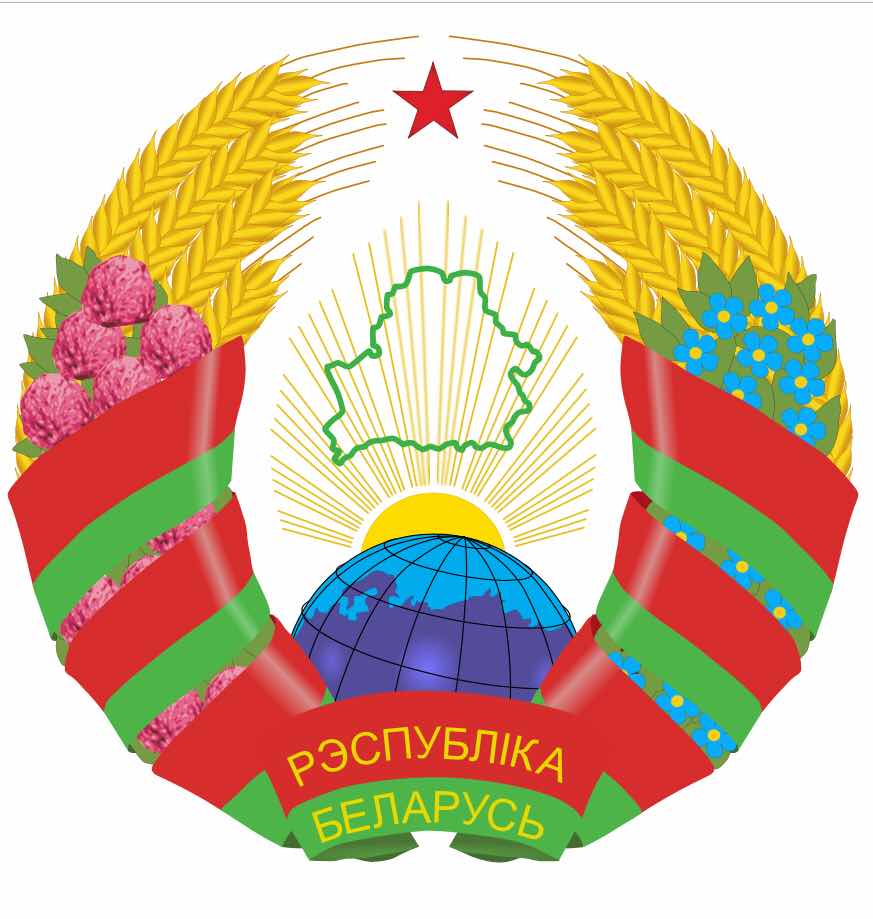
16 th definitive series - National emblem of Belarus - 2016 - face value - 10 kopeks 

In the center of the emblem sits a green outline of Belarus, superimposed over the rays of a golden sun. The sun is partially covered by a globe, with the landmass (part of Eurasia) in purple and waters in blue. Lining the left and right sides of the emblem are stalks of wheat, superimposed with flowers. Clovers adorn the left wheat stalks; flac flowers adorn the right. Wrapped around the wheat stalks is a red and green ribbon bearing the colours of the flag of Belarus; the ribbon meets at the base of the emblem, where the name Republic of Belarus(Рэспубліка Беларусь) is inscribed in gold. At the top of the emblem there is a five-pointed red star.

The postage rate of BelPost - 


The total postage on the cover - 5x A ( 0.42) + 2x 0.10 = 2.3 BYN  ( around ₹78/- or USD 1.2 ) 

Saturday, July 21, 2018

A Belarusian bird brings my postcrossing envelope


Belarus ! Honestly , a couple of years ago , I have never known there was a country called Belarus . The numerous new republics of the erstwhile Soviet Republic confuse me ! But the beautiful postcrossing stamps of Belarus caught my fancy. 

Thanks to Nastassia - I got this beautiful envelope - a first day cover of the Belarusian postcrossing stamp along with the earlier postcrossing stamp of Belarus too on the cover ! And she sent me a fauna of Belarus postcard too, because I like bird postcards :) 

January, 3, 2017. Happy Postcrossing. A self-adhesive stamp for M rate (international priority postcard).
The stamp present a girl with a crown of cornflowers (a flower symbol of Belarus), in a dressed of the same colour, holding a heart-shaped postcard with a cornflower stamp and happy postcrossing wishes. The postcard also has the rushnik embroidery pattern on it . 

The blue cornflowers is a symbol of prosperity in Belarus - a Slavic folklore. And Nastassia had written another Slavic folklore in her postcard ! 

Belarus definitely looks stunning ! And googling about Belarus took me to this wonderful blog - http://mynativebelarus.blogspot.com/?m=1

And this wonderful thread on Belarus stamps 

 I travelled through the entire Belarus in time and place through this envelope :) 

Update : 


cornflower or bachelor's button, is an annual flowering plant, native to Europe.  In the past it often grew as a weed in corn fields . It is now endangered in its native habitat by agricultural intensification, particularly over-use of herbicides, destroying its habitat. It’s called bachelor’s button, because it was worn by young men in love ( according to local folklore ) 
It is a national flower of Estonia. It was a favourite flower of Kaiser Wilhelm -1 of the famous WW1! And so pro - German activists in Austria wore blue cornflowers in their shirts as a loyalty to Germany . These flowers are the symbol for US- Germany joint festivals , and also for the Nov 11 th rememberance day in France ! 


The Belavia airlines sports the colour on its tail - the cornflower blue !