Showing posts with label Karl Marx. Show all posts

Monday, February 4, 2019

Vietnam India joint relations


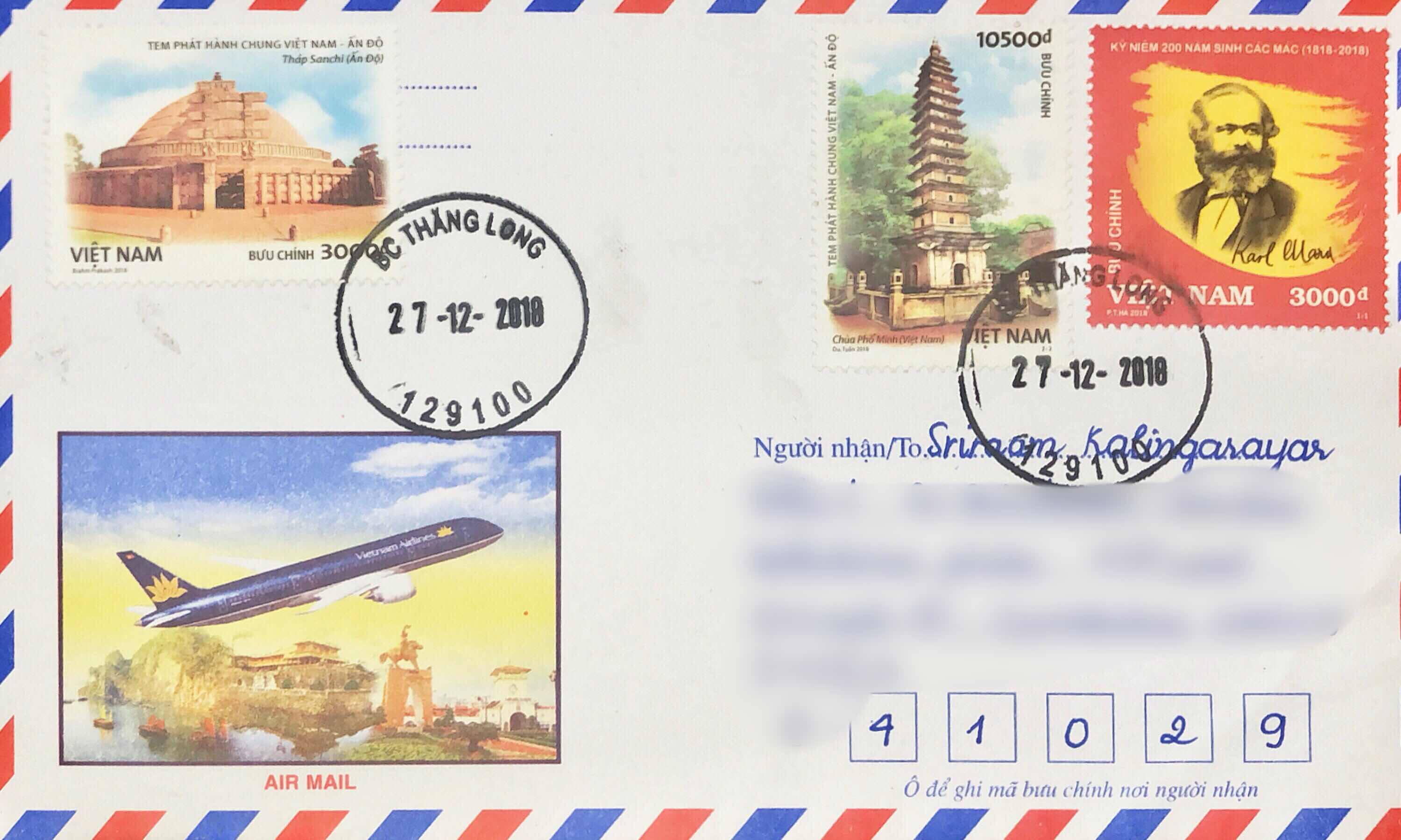
A cover from Vietnam with Karl Marx stamp and the India - Vietnam Joint Issue stamps 

The civilizational relationship between India and Viet Nam spans over 2000 years. Monks, traders and people from both countries have interacted over centuries. The intense cultural exchanges have enriched the cultural diversity of the region. India and Viet Nam enjoy good relations and have established bilateral cooperation mechanisms. The relations between the two countries are marked by strong trust, mutual understanding and convergence of views on various international issues and the regional security situation in Asia.

In recent times, political contacts have strengthened as reflected in several high-level visits by leaders from both sides. Trade and economic linkages continue to grow. Viet Nam is an important regional partner in South East Asia. India and Viet Nam closely cooperate in various regional forums such as ASEAN, East Asia Summit, Mekong Ganga Cooperation, Asia Europe Meeting (ASEM) besides UNand WTO.

India and Viet Nam have emphasized that enhancing bilateral economic engagement is a strategic objective. The bilateral trade is growing at a healthy pace.

In 2017, the two countries have celebrated the 45th Anniversary of the establishment of diplomatic relations and the 10th Anniversary of Strategic Partnership. The theme for the joint issue is “Ancient Architecture”, depicting “Sanchi Stupa” in the Indian stamp and “Pho Minh Pagoda” in the Viet Nam stamp. The Sanchi Stupa and the Pho Minh Pagoda are architectural landmarks of their respective countries and are tied by the common thread of Buddhism.
Sanchi Stupa:

  • The Great Stupa at Sanchi is one of the most important Buddhist monuments. Located at Sanchi town, Madhya Pradesh, India, this Stupa is the oldest stone structure in India that was built during the Mauryan period. Originally commissioned in the third century B.C. by Emperor Ashok, this huge hemispherical dome with a height of 54.0 ft consists of a central chamber where the relics of Lord Buddha are placed. Four ornamental gateways facing four directions and a balustrade surrounding the Stupa were later added in the first century B.C. Enlisted as a UNESCO World Heritage Site since 1989, it is counted among the best conserved ancient Stupas of central India.
  • The present hemispherical edifice is double in diameter of the original brick structure built by Ashoka, consisting of the relics of Lord Buddha. A chatra that is an umbrella like structure made of stone crowned the hemispherical brick structure that was surrounded by a wooden railing. A sandstone pillar, inscribed with Edict by Ashoka as also with ornate spiral Brahmi characters from the Gupta period resembling conch shells referred as ‘Shankhalipi’ or ‘shell-script’ by scholars, was erected in the site. While the lower portion of it is still grounded, the upper portions are kept under a canopy. During the Shungadynasty, expansion of the Stupa, nearly double its original size with a more flattened dome was undertaken using stone slabs that entirely covered the actual brick Stupa. Three superimposed umbrella-like structures were built to crown the dome. It symbolized the Wheel of Law or ‘dharma’. A high rounded drum that can be reached through a double staircase became the seat of the dome enabling one to circumambulate the sacred dome.
Pho Minh Pagoda:

  • Pho Minh Pagoda is located 4 km north of Nam Dinh City and 94 km south of Hanoi, the Capital city. The pagoda was originally built during the Ly Dynasty of Viet Nam and later expanded in 1262 during the Tran Dynasty. It was a place for high-ranking mandarins and the aristocracy of the Tran Royal Court to worship and lead their religious life.
  • The architecture and decorations of the pagoda are characteristics of the Tran Dynasty’s times: lotus flower pond, lotus-flower decorations at the foot of the pillars, the Tran-styled dragon sculptures, the stone candle holders. Specially, a 13 story-tower named Pho Minh Tower in the shape of a lotus, 19 meters high, was built just in front yard of the pagoda in 1305. The base and the tower’s first floor were constructed with flagstones and the upper floors were built with bricks. On top of the tower, there is a gourd-shaped decoration which is kind of talisman to catch the elite energy from the universe. The tower is believed to connect the Earth and the Universe. Pho Minh Pagoda is mostly visited by the Vietnamese Buddhist Pilgrims and tourists, especially in festival times.


Friday, January 11, 2019

Marxism in Vietnam


A cover from Vietnam with stamps on Karl Marx and October Revolution 


The stamps mark the 200th birth anniversary of Karl Marx and 100th anniversary of October revolution of Russia ! 


Karl Marx was the founder of the theory of Communism and October Revolution was the first step in the spread of Communism across the world ! 

The northern part of Vietnam was part of Imperial China for over a millennium, from 111 BC to AD 939. An independent Vietnamese state was formed in 939, following a Vietnamese victory in the battle of Bạch Đằng River. Successive Vietnamese imperial dynasties flourished as the nation expanded geographically and politically into Southeast Asia, until the Indochina Peninsula was colonised by the French in the mid-19th century.
 Following a Japanese occupation in the 1940s, the Vietnamese fought French rule in the First Indochina War. On 2 September 1945, President Hồ Chí Minh declared Vietnam's independence from France under the new name of the Democratic Republic of Vietnam. In 1954, the Vietnamese declared victory in the battle of Điện Biên Phủ which took place between March and May 1954 and culminated in a major French defeat. Thereafter, Vietnam was divided politically into two rival states, North Vietnam (officially the Democratic Republic of Vietnam) and South Vietnam(officially the Republic of Vietnam).
 Conflict between the two sides intensified in what is known as the Vietnam War with heavy intervention by the United States on the side of South Vietnam from 1965 to 1973. The war ended with a North Vietnamese victory in 1975. Vietnam was then unified under a communist government but remained impoverished and politically isolated. 
In 1986, the Communist Party of Vietnam (CPV) initiated a series of economic and political reforms that began Vietnam's path toward integration into the world economy. By 2010, it had established diplomatic relationswith 178 countries. Since 2000, Vietnam's economic growth rate has been among the highest in the world, and in 2011, it had the highest Global Growth Generators Index among 11 major economies.
Vietnam and Laos are the two countries in the IndoChina peninsula with Communist Geovernments. 

Thanks Do Quoc Minh for the nice cover ! 

With this cover - I have collected all the stamps issued for bicentennial birth anniversary of Karl Marx - on covers - from all the 5 countries that issued in 2018 ! 

Tuesday, December 4, 2018

Karl Marx from China


I received a cover from China with the bicentennial anniversary of Karl Marx stamps of China ! 

This is the fourth cover with Karl Marx stamps of 2018! 


A bronze statue of Karl Marx (1818-83) gifted by China was unveiled in his hometown of Trier, Germany, on May 5 to mark his 200th birthday. The sculpture was created by Chinese artist Wu Weishan who is also the director of National Art Museum of China in Beijing. On the same day, China Post released a set of two stamps, one of which features the image of the sculpture.
On the stamp, with a face price of 1.2 yuan (less than 50 US cents), the statue is set against a drawing of Marx's former residence in Trier.
The other stamp of this commemorative set shows two bronze statues of a seated Marx and behind him, a standing Friedrich Engels (1820-95), both created by Wu; and in the background there are covers of Marx's best known titles: the German and Chinese versions of The Communist Manifesto and a Chinese version of Capital.
Thanks Chen for the cover :) 
I am hoping to receive the Vietnam one also on cover soon :) 

Sunday, November 18, 2018

Russia and Karl Marx


I received a cover with the Karl Marx of Russia too ! 

I guess I have written enough and more about Karl Marx and Marxism in two previous posts - when I received covers with Marx stamps from Germany and Kyrgyzstan. 

Karl Marx, a German philosopher, is known for his revolutionary political ideas during the Russian Revolution. He established the idea of “materialist conception of history”, meaning how society and the economy is organized is determined by changes material conditions. He published this thesis in his manuscript called The German Ideology. While writing The German Ideology, Marx also joined the Communist League, an international proletarian organization, and wrote a polemic against P.J. Proudhon’s idealistic socialism.
Vladimir Lenin was a theorist and communist philosopher during the Russian Revolution and a serious follower of many of the Marxist ideals. He is remembered as one of the greatest revolutionaries in history for many reasons, first being, founding and leading the Bolshevik Party. This contribution led to the creation of the Russian Soviet Federative Socialist Republic, which marked the beginnings of the Soviet Union. 

Thanks Alexey for this nice cover ! 

I hope to receive the Karl Marx stamp of China also soon !! 

Update : 29-01-2019

Thanks Kira for this cover ! Yet another cover with Russian Karl Marx stamp :) 


Tuesday, November 6, 2018

Kyrgyz Karl Marx


A post from Kyrgyzstan via KEP ( Kyrgyzstan Express Post ) ! 

There are two postal authorities in Kyrgyzstan- with each one issuing their stamps. But unlike Bosnia Herzegovina, the postal authorities function through out the country and are not restricted to any particular regions ! 

Kyrgyzstan is one of the former USSR countries. The country was one of the regions where Marxism and Socialism thrived a few decades ago. So it is natural that the country has issued stamps honouring Karl Marx’s 200th birthday 


I had received an enevelope with German Stamp honouring Karl Marx’s 200th birth anniversary 

Marxist ideas were not restricted to Germany or Europe, but spread wide across and found firm base in China and USSR. 
Like Hegel, Marx understood history as the story of human labour and struggle. However, whereas for Hegel history was the story of spirit’s self-realization through human conflict, for Marx it was the story of struggles between classes over material or economic interests and resources. In place of Hegel’s philosophical idealism, in other words, Marx developed a materialist or economic theory of history. 

Before people can do anything else, he held, they must first produce what they need to survive, which is to say that they are subject to necessity. Freedom for Marx is largely a matter of overcoming necessity. Necessity compels people to labour so that they may survive, and only those who are free from this compulsion will be free to develop their talents and potential. This is why, throughout history, freedom has usually been restricted to members of the ruling class, who use their control of the land and other means of production to exploit the labour of the poor and subservient. The masters in slaveholding societies, the landowning aristocracy in feudal times, and the bourgeoisie who control the wealth in capitalist societies have all enjoyed various degrees of freedom, but they have done so at the expense of the slaves, serfs, and industrial workers, or proletarians, who have provided the necessary labour.

This is a volatile situation, according to Marx, and its inevitable result will be a war that will end all class divisions. Under the pressure of depressions, recessions, and competition for jobs, the workers will become conscious that they form a class, the proletariat, that is oppressed and exploited by their class enemy, the bourgeoisie. Armed with this awareness, they will overthrow the bourgeoisie in a series of spontaneous uprisings, seizing control of factories, mines, railroads, and other means of production, until they have gained control of the government and converted it into a revolutionary dictatorship of the proletariat.


Marx and Engels developed a body of ideas which they called scientific socialism, more commonly called Marxism. Marxism comprised a theory of history (Historical Materialism) as well as a political, economic and philosophical theory. His philosophy of “Scientific Socialism” is developed in the Manifesto of the Communist Party(written in 1848 just days before the outbreak of the revolutions of 1848), the Critique of political economy and the Das Kapital (Considered as Bible of Socialism).


I hope I am able to collect the Karl Marx bicentennial stamps of China and Russia too ! 


Tuesday, September 4, 2018

Karl Marx of Germany


Karl Marx was a German philosopher and a revolutionary socialist . He was born in Trier , Germany on 05-05-1818. This year marks the 200th birth anniversary of the great economist , whose philosophy and books ( Das Kapital ) spearheaded democracy , communism and socialism in various countries. Because of his works and growing unpopularity with the capitalist governments , he remained stateless and died in 1883 in London. 

The German postal service has released a postage stamp, designed by visual artist Thomas Mayfried, to commemorate the 200th birthday of Karl Marx.
The design was the winner of a competition run by the German Federal Ministry of Finance to create a stamp to celebrate the anniversary of Marx's birth on the 5 May 1828. Mayfried, who is based in Munich, created the stamp using a now iconic photograph of Marx taken in 1875 by English photographer John Mayall.
Described by German philosopher Fredrich Engels as "completely in his cheerful, victorious Olympian peace", the image depicts Marx in portrait form, facing the camera from a side angle.The design also includes Marx's name in a Sans Serif font, as well as the years of his birth and death.Previous stamps have depicted the writer of the Communist Manifesto with a red background – a colour associated with Marxism.But Mayfried’s design abstracts his portrait with black and white lines. 
The cancellation is from Trier, his birthplace and depicts a portrait of him along with his birth and death dates . 
The envelope was posted on 28-July and reached me almost after a month on 2nd September - very unusual of Deutsche Post ! 

Update - 


I had received this postcard from a Postcrossing meetup at Trier a month ago . The meetup was organised for the release of the Karl Marx stamp too. The postcard shows the place / house where Karl Marx lived in his younger days ( decades before he was exiled ) . The card is printed in red , to mark the colour of his communist philosophy ! 

Reasons for the colour - Red 
The most popular reason I have come across in my search is that - the colour red symbolises the blood ( shed ) of the working class . The other reasons - the colour of disobedience / to send a message to the capitalists , etc . The colour red was adopted by the revolutionaries as early as during the Paris Commune , and then became popular in the French Revolution , subsequently during the October revolution . The Red flag was adopted by USSR and China as their national flags !