Showing posts with label # Israel. Show all posts

Saturday, February 9, 2019

Israel and the World - part 6


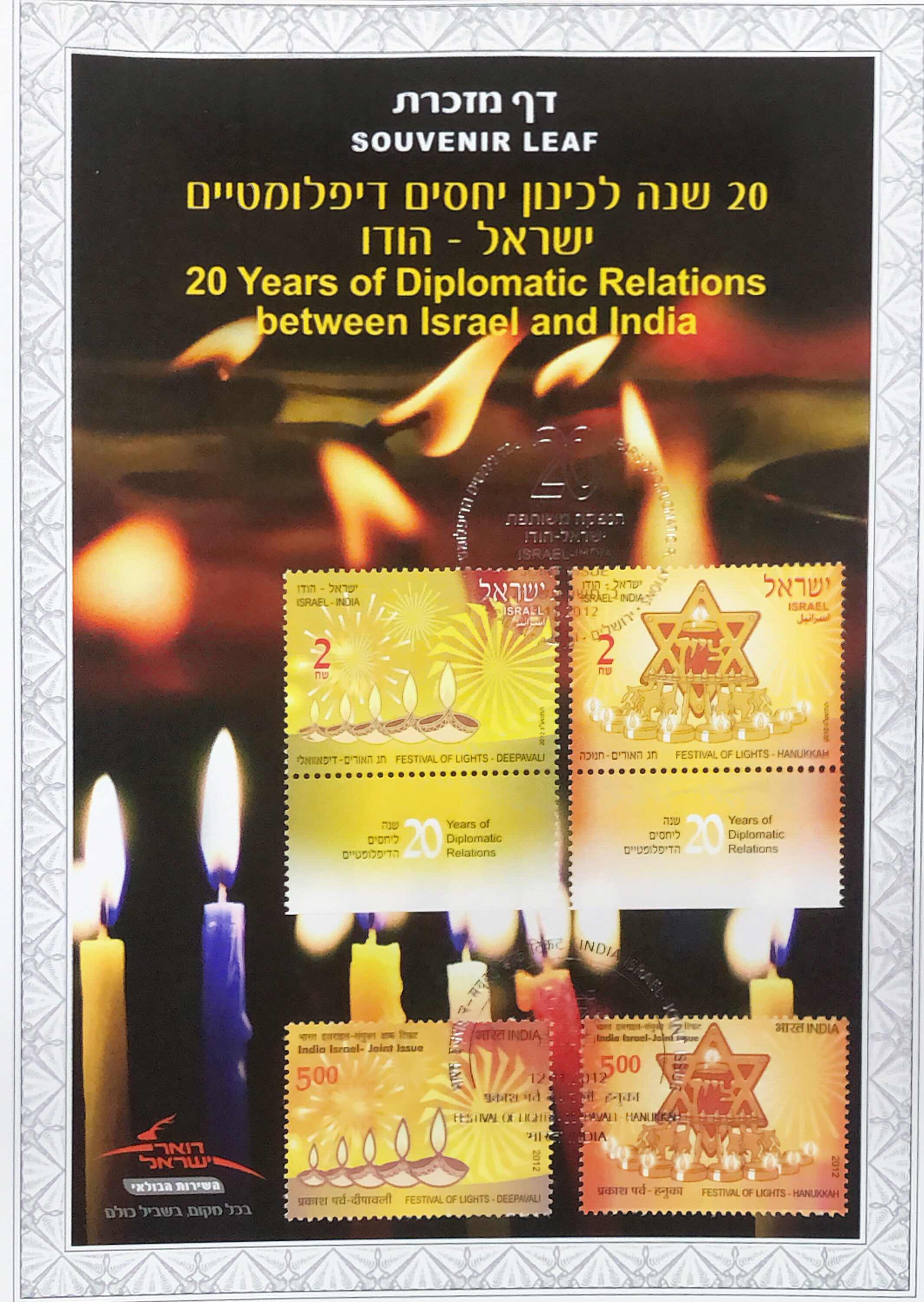
A cover from Israel with Israel - India joint issue 

Israel - India Joint Issue 
Israel and India issued stamps to honour their diplomatic relations with the common theme of Festival of Lights 


 Hanukkah  is a Jewish festival commemorating the rededication of the Second Temple in Jerusalem at the time of the Maccabean Revoltagainst the Seleucid Empire. It is also known as the Festival of Lights 

The Maccabees successfully rebelled against Antiochus IV Epiphanes. According to the Talmud, a late text, the Temple was purified and the wicks of the menorah miraculously burned for eight days, even though there was only enough sacred oil for one day's lighting.
Many families exchange gifts each night, such as books or games, and "Hanukkah Gelt" is often given to children. Fried foods (such as latkes (potato pancakes), jelly doughnuts (sufganiyot), and Sephardicbimuelos) are eaten to commemorate the importance of oil during the celebration of Hanukkah. 

Deepavali  is the Hindufestival of lights, which is celebrated every autumn in the northern hemisphere (spring in southern hemisphere). One of the most popular festivals of Hinduism, Diwali symbolises the spiritual "victory of light over darkness, good over evil and knowledge over ignorance." Light is a metaphor for knowledge and consciousness. During the celebration, temples, homes, shops and office buildings are brightly illuminated. The preparations, and rituals, for the festival typically last five days, with the climax occurring on the third day coinciding with the darkest night of the Hindu lunisolar month Kartika

Both the festivals are celebrated for the common cause - victory of Good over Evil 

India is the largest buyer of Israeli military equipment and Israel is the second-largest defence supplier to India after Russia. From 1999 to 2009, the military business between the two nations was worth around $9 billion. Military and strategic ties between the two nations extend to intelligence sharing on terrorist groups and joint military training.

As of 2014, India is the third-largest Asian trade partner of Israel, and tenth-largest trade partner overall. In 2014, bilateral trade, excluding military sales, stood at US$4.52 billion.

Thanks Micha for this awesome cover and the souvenir leafs inside :) 


Tuesday, December 4, 2018

Merry Christmas from Israel


A cover from Israel - with Christmas greetings ! 


Season’s greetings from the Holyland ! 

The concept combines Christmas signs, like snow, trees and the atmosphere of a cool night in Bethlehem, and the occasion and the reason for that holiday, which is of course the birth of Jesus Christ.

The message in the design is about the light and the salvation that he brought with him at the time of his birth, hence, the great star, even in the stamp, which is indicative of light and happiness and the strong connection between a mother and her son.

The cancellation shows the birth of Christ with Mary and Joseph by the side and the star ! 


The stamp is an ATM label . 

variable value stamp, is a gummed or self-adhesive postage stamp of a common design, issued by a machine similar to an Automatic Teller Machine, with a value of the user's choice printed at the time the stamp is dispensed. The value may be variable or from a fixed selection of postal rates. The stamps and machines are typically for use in retail or post office environments. As only the postal value varies from stamp to stamp, these stamps have been described as key type stamps. They are also closely related to meter stamps from postage meters.

As the concept has developed, a variety of different names have been used, including Automatenmarken (Germany), ATM stamps (USA), Autopost stamps (USA), Frama labels (Europe) or machine labels(Stanley Gibbons catalogues)


Thanks Yuri for the beautiful cover and Merry Christmas to you too ! It’s quite a nice feeling to receive a Christmas wish from the Holyland itself ! 


Update : 

Received another cover with Christmas Eve cancellation ( 24-12-2018 ) from Nazareth ! 


Christmas covers from Bethlehem and Nareth ! 😇


Update : 

One more cover from Israel - this one from Jerusalem ! 


Jerusalem , Nazareth and Bethlehem !! 😇😇😇

Monday, December 3, 2018

Israel and the World - part 5


Fifth cover from Israel with the joint issue stamps 

1. Israel - Poland joint issue 

2018- This year Israel celebrates 70 years of independence and Poland – 100 years since regaining independence after decades of occupation by its neighbors.
The Polish and the Jewish peoples have a long and rich common history with many peaks but also valleys, until the Holocaust effectively ended the large Jewish presence on Polish soil.

Since Poland was liberated from Communism, it has proven to be one of Israel’s closest friends. Relations between the two countries are blossoming in all fields – culture, trade, technology and tourism. In the past year, mutual tourism increased by tens of percentage points, a phenomenon that strengthens the friendship between the states and the peoples even more. This joint stamp issue, which is not the first between Israel and Poland, along with innumerable cultural collaborations, are a testament to the increasing partnership and close relations.

During the course of the many meetings Israeli diplomats attend in various places throughout this large country, we are met with immense friendliness and frequently great curiosity regarding Israel, which allows us to organize numerous cultural and technological activities. Poland is also extremely friendly to Israel in the political realm – both in supporting and cultivating our mutual relations as well as in international forums. The most prominent example of this is Poland’s abstention during the United Nations vote to condemn the U.S. decision to recognize Jerusalem as the capital of Israel.

2. Israel - USA Joint Issue 


The stamp art features a Hanukkah menorah created using the technique of papercutting, a Jewish folk art, by artist Tamar Fishman. Behind the menorah is a shape that resembles an ancient oil jug representing the miracle of the oil that burned in the candelabra in the Holy Temple in Jerusalem after its sacking and recapture for the eight days necessary to resupply. Additional design elements include dreidels and a pomegranate plant with fruit and flowers.

The stamp also is meant to celebrate 70 years since the establishment of diplomatic relations between Israel and the United States, Israel Post said in a statement.

The new stamp design was launched simultaneously in the Touro Synagogue in Newport, Rhode Island, the oldest synagogue in the United States, and at the American Center in Jerusalem.

Five beautiful covers with Israel Joint issues . Thanks Mikhail ! 

Sunday, December 2, 2018

Israel and the World- part 4


The fourth cover of Israel Joint issues 

1. Israel - Uruguay Joint Issue 
The South American and Israeli postal companies chose a drawing by the artist Jose Gurevich of the Matriarch Sarah when she was told by angels that she would have a son. The Jewish-Uruguayan artist had created a series of biblical drawings in honor of his mother who contracted cancer. The image on the NIS 2 stamp designed by Rinat Gilboa testifies to the deep cultural and religious roots of the Jewish People. Uruguay was the first country to recognise Israel and the stamp honours the 65 years of their friendship . 


2. Israel - Estonia Joint Issue 

Interestingly, the diplomatic ties between Estonia and the region of Palestine have a longer history. The Republic of Estonia appointed an Honorary Consul to the British Governor of Palestine in 1929 and the Honorary Consulate of the Republic of Estonia was located at Litwinsky House. Today, Estonia and the State of Israel consider themselves similar in many ways. Both countries are proud of being modern young states ready to accept the technological and security challenges of the 21st century. Both countries are recognized world leaders in the IT and cyber security realm  and both boast an impressive number of start-up companies. The contacts and cooperation between Estonia and Israel, in their private as well as public sectors, are expanding to include the whole realm of economic and technological innovation.

A Jewish presence in Estonia was first recorded in 1333, but their numbers remained small until the 18th century. The Republic of Estonia granted Jews cultural autonomy in 1926 – the first country in Europe to do so. This cultural autonomy was renounced in 1940 as a result of the Soviet occupation and restored after Estonia regained its independence in 1991.

Today there is a smaller, but very dynamic and active Jewish community in Estonia, numbering approximately 2000 members. There is a synagogue (reopened in 2010) and Jewish Cultural Center in Tallinn as well as a Jewish school, kindergarten and social center.

The Litwinsky House is an outstanding architectural building in Tel Aviv. It was built by Yaakov Elhanan Litwinsky (1852-1916), a well-known businessman who immigrated from Odessa. Before that he had purchased one of the original sixty-six lots in Ahuzat Bayit, the nucleus of the future Tel Aviv. The house he built with his family at 22 Achad Ha’am Street was one of the most impressive homes in the new neighborhood.

3. Israel - Russia Joint Issue 


Christian tradition calls the village of Ein Karem, located to the west of Jerusalem, the "City of Judea". The Virgin Mary visited Ein Karem while carrying her unborn child Jesus and according to the New Testament, she met her cousin St. Elizabeth there, while she was also pregnant with her son, John the Baptist. On the hillside above the village there is a large, magnificent gold-domed church which is part of the Russian convent complex that was built in honor of that visit. Construction of the convent and the church began in the 19th century, initiated by the head of the Russian religious mission to the Holy Land. These buildings reflect the deep Russian religious involvement in Eretz Israel toward the end of the Ottoman Period, when tens of thousands of devout Russians made the pilgrimage to the Holy Land every year.
 In 1871, Archimandrite Antonin Kapoustin, head of the Russian religious mission, purchased a large plot of land in Ein Karem with funds contributed by devout businessmen and noblemen. He planned and built a modest church at the center of the complex and invited wealthy women who wished to live out their lives in the Holy Land to build houses there. Those houses were subsequently inherited by the community, thus over time a few dozen buildings were incorporated into the Russian Gorny ("mountainous") Convent. In 1910, Leonid Sinzov, one of the heads of the Russian religious mission after Kapoustin, decided to build a new larger and grander church up on the hillside, which he planned to call "The Church of the Holy Trinity". In order to build the church, Sinzov borrowed large sums of money from various parties. He also expected to receive contributions to complete the construction. But these plans came to an abrupt halt when WWI broke out in 1914. Contact with Russia was severed and the Russian representatives, who were declared to be enemy subjects, were deported to Egypt and construction of the church stopped. After the war, it was impossible to continue the construction due to significant debts and the severance of ties with the anti-religious Soviet Union.
 The roofless church stood abandoned for decades, until the early 21st century, when construction recommenced. The church was completed in 2007 and named the "Cathedral of All Russian Saints". In recent years, this typical Russian-looking church is visited by increasing numbers of tourists and pilgrims and it represents Russia's deep religious bond to Jerusalem.

To be continued ... 


Israel and the World - part 3


A third cover from Israel with Joint Issue stamps 

1. Israel - Portugal Joint Issue 


The Jewish people have ancient ties to Portugal, but the Portuguese Jewish community experienced dramatic changes beginning in the early 15th century: expulsion, forced conversion and the Inquisition. In 1989, a formal apology from the Portuguese people was issued to the Jews and in 1996 the Decree of Expulsion was nullified on the 500th anniversary of its issuance. 

During WWII, many Jews passed through Portugal, mostly immigrating to other countries and later also to Israel.Israel recognized four Portuguese "Righteous Gentiles". The most well known is Aristides de Sousa Mendes, who issued visas to thousands of Jews while serving as the Portuguese consul-general in Bordeaux, France during the Holocaust.

This stamp is issued to mark 40 years of friendship between the two countries. 

Common Bottlenose Dolphin. (Tursiops truncatus) belongs to the family Delphinidae and is most commonly found in tropical to temperate oceans, mainly in the shallow waters of the continental shelf, where water depths are up to 200 meters. Mature dolphins range from 2-4 meters in length and weigh between 150-650 kgs. 

2. Israel - Germany Joint Issue 


Fifty years ago on May 12, 1965, as the agreement establishing German-Israeli diplomatic relations was signed, no one could have imagined that Israel and Germany would be the close allies they are today. Relations between Israel and Germany developed against the background of Nazi Germany's role in the genocide of the Jewish people during the Holocaust. Two statesmen, David Ben-Gurion, one of the founders and first Prime Minister of Israel, and Konrad Adenauer, the first Chancellor of the Federal Republic of Germany made it possible, against all odds, for the two countries to engage in direct exchange. The way was paved mainly by the civil societies on each side. They built the important bridges between people in both countries. 

In 2003, the White City of Tel-Aviv was proclaimed a UNESCO World Heritage Site thanks to its many buildings designed in the international style known as Bauhaus architecture. 

The Bauhaus school was founded in Germany after WWI. Its goal was to provide an innovative solution suitable to the high social standards of that time. New construction technologies enabled by the industrial revolution were utilized by the school.The fifth Aliyah (1933-1939) brought numerous wealthy people to Eretz Israel, along with many construction professionals. The population also increased greatly, creating a severe housing shortage. 

The new style of building provided a solution to this problem, as well as a way to differentiate "Hebrew" construction from both the local Eastern style and the classic European style that raised extremely difficult memories.

The international architectural style inspired by the modern movement provided unique local solutions suited to the geographical area as well as to the spirit of the place. The "German" Aliyah left its mark on more than the architecture itself. Many construction-related German words, such as "spachtel" (putty knife), are used in Hebrew to this day.

The stamp features the Beit Bruno building located 3 Strauss St. which was built by architect Zeev Heller in 1935.The stamp tab features the logo marking 50 years of diplomatic relations between Israel and Germany. The logo was designed by Ariel Wollek of Israel and Ticha Matting of Germany - winners of a competition initiated by the Israeli and German Foreign Offices.


To be continued ... 

Israel and the World - part 2


The second cover from Israel with four sets of Joint Issue stamps Of Israel 

1. Israel - Greece Joint Issue 

The stamp features Haifa Port as represented by a typical freighter and cranes, with the Baha'i Gardens on the slopes of Mt. Carmel in the background; and the Port of Thessaloniki as represented by a typical cruise ship and cranes, with the ancient white tower on the beach in the background. 

The stamp tab features the 25 Years of Diplomatic Relations between Israel and Greece logo, designed by graphic artist and illustrator Kelly Matathia Covo. Both are modern democratic states, Mediterranean neighbors, with common values representing the proud independence of two ancient nations. The two countries have forged a multidimensional partnership with wide-ranging cooperation in all fields reflecting our peoples' shared history, close cultural ties and common interests.

2. Israel - Spain Joint Issue 

The Bridge of Strings is a cable stayed bridge built at the entrance to Jerusalem as part of the municipal light rail project. It was designed by Spanish architect Santiago Calatrava. The bridge allows the light rail to cross from Jaffa Road to Herzl Blvd. and also serves as a pedestrian bridge. It was designed as a modern gate and a new symbol of the city of Jerusalem. The bridge is 360 meters in length, weighs 4500 tons and utilizes some 10 kilometers of suspended cables. The angled mast on the side of the bridge is made of special steel and soars to a height of 118 meters. It is connected to the pavement below by 70 cables. These cables bear the full weight of the bridge with no supporting beams whatsoever. The inspiration for the design comes from a verse in the Book of Psalms, 150:3: Praise Him with harp and lyre. According to Calatrava, "I felt that David's city should have a bridge that resembled a harp or a violin, the instrument that he played".

Construction of the bridge began in 2005 and was inaugurated on June 25, 2008. Santiago Calatrava, born in 1951, is a Spanish engineer and architect whose style is original and unique. He has designed public buildings and suspension bridges around the world. He integrates his vast engineering knowledge and his architectural skills into his works to create aesthetic structures inspired by nature. Calatrava's unique style is characterized by the color white, extensive use of cables, arches, steel beams, stone and glass to create a "transparent" effect and organic shapes.

3. Israel - Philippines joint issue 

The relations between Israel and the Philippines are founded upon two events that were morally and politically significant for the Israeli and Philippine peoples. 

The first event was the decision made by Manuel L. Quezon, the President of the Philippines at the time, to open his country's gates to Jewish refugees from Germany and Austria on the eve of WWII, which stood in stark contrast to the conduct of the "enlightened" nations during that period. 

The second event was that the Philippines was the only Asian country to vote in favor of Israel at the United Nations on November 29, 1947 during the historic decision that led to the establishment of the State of Israel and the recognition thereof by the family of nations. 

This friendly relationship is also related to the fact that Israel is the Holy Land and the land of the Bible, which greatly affects the Philippino people. According to a study conducted by the Anti-defamation League, the Philippines is one of the only countries in the world that has virtually no anti-Semitism, a fact that is in line with the two countries’ joint history. Israel has a significant Filipino population, whose contribution to the welfare for incurable patients and the disabled is greatly appreciated.


The Open Doors Monument is located at the center of the Memorial Garden in the city of Rishon LeZion. It was dedicated in 2007 and marks the assistance the Philippines provided to Jewish refugees during WWII. 

In the late 1930's most countries of the world closed their doors to Jews who were being persecuted by the Nazi regime. During this difficult period Philippine President Manuel L. Quezon agreed to issue 10,000 immigrant visas to European Jews. Some 1,300 Jews utilized these visas to immigrate to the Philippines. Many of them worked in the cigarette factory founded by the Freidar family in Manila and lived in blocs that President Quezon had built especially for them. 

The monument, created by Philippine artist Mr. Jun Yee, consists of three doors in graded sizes symbolizing the courage and humanity of the Filipino people in welcoming the Jewish refugees. The triangular shape of the open doors represents the triangle on the Philippine flag and the triangles that comprise the Star of David. This integration of triangles is a symbol of the close friendly ties that exist between the Philippine Republic and the State of Israel. 

The concrete floor below each door features an impression of a pair of feet crossing the threshold into the open door. These footprints belong to George Levinstein, a Jewish refugee who arrived in the Philippines in 1939, Max Weissler, who arrived in the Philippines in 1941 at age 11 and Dorilis Goffer, a 10-year old Filipino Israeli girl who is the granddaughter of Holocaust survivors. Her footprints represent the continued friendship between the two countries. 

4. Israel - Croatia Joint Issue 

Crown Anemone (Anemone coronaria)
From the moment the first Anemones bloom, it is impossible to ignore them, even from a distance. Anemones face the sun and follow it throughout the day. This flower acts like a concave mirror, concentrating the sun's rays and warming the stamens and stigmas at its center to as much as ten degrees above the temperature in the surrounding area. This heat speeds up the germination of the pollen grains, thus reducing the chance that they will be washed away by rain.
In many places the Crown Anemone blooms in numerous different colors, mainly white, blue and purple, in addition to red. All have the same fragrance.
Surprisingly, the wind is responsible for most of the pollination and all of Israel's Crown Anemones belong to a single genetic population, with no significant differences. In the Southern part of the country grow only red flowers, which are more resistant to the drier conditions. 


Croatian Iris (Iris croatica Prodán)

The only place in the world in which the Croatian Iris grows is on the forested limestone hills in western Croatia. It was not defined scientifically until 1962 and by 2000 it was declared by the Croatian Academy of Arts and Science as Croatia's national flower. This plant is known as Perunika in honor of Perun, the highest god of the pantheon and god of thunder and Lightning in Slavic mythology. Legend has it that Perunika only grows where lightning has struck the ground. A special folk dancing festival named for the Iris is held in May, when the flowers bloom. The Croatian Iris is used to create especially beautiful hybrids with other iris species and its beauty and resistance make it a popular garden plant.
The rhizomes contain essential oils and fragrant resins. Powder prepared from the rhizome is used in folk medicine, as well as in the preparation of perfumes and for other cosmetic purposes.


To be continued ... 


Israel and the World


First cover with three joint issues of Israel 

1. Israel - Vatican Joint Issue 


While the visit by Pope Francis to Israel in May 2014 was officially described as a pilgrimage to the Holy Land, he participated in two events bearing both historic significance and importance for the future: the Pope met with the Orthodox Patriarch Bartholomew I (to mark the 50th anniversary of the historic meeting between Pope Paul VI and Patriarch Athenagoras  I); and placed a wreath at the gravesite of Theodor Herzl, the founder of modern Zionism, another indication of the strengthening ties between Israel and the Vatican, and between Judaism and the Catholic Church.

2. Israel- Bulgaria Joint Issue 


Israel and Bulgaria share a strong, unique historical bond.The joint efforts of the Bulgarian people, the Church and the Parliament saved the Bulgarian Jewish community during WWII, adding an exceptional human dimension to the diplomatic relations between the two countries.

The stork is connected to human habitats and in Europe it signifies the arrival of spring and symbolizes hope. Some 600,000 storks migrate through Israel's skies twice a year, among them probably all of Bulgaria's storks.

3. Israel - Malta Joint Issue 


Israel and Malta issued a joint postage stamp to mark 50 years of diplomatic ties between the countries and recall the shared history of the Order of the Knights Hospitallers that began in Jerusalem in the Middle Ages. 

The Order of the Knights Hospitallers was founded in Jerusalem in the 12th century and established its center south of the Church of the Holy Sepulchre. During the Crusader period the knights, who were also known as the Order of the Hospitallers of St. John of Jerusalem, were tasked with aiding Christian pilgrims to the Holy Land by providing protection and medical services. After the defeat of the Crusaders at the 1187 Battle of Hattin, the Hospitallers retreated to Acre where they built halls and community centers, some of which are still standing today.

In the later Middle Ages, facing the advancing Muslim armies, the Hospitallers were forced out of Acre and were granted the island of Malta by Holy Roman Emperor Charles V, founding their own state on the island with its capital at Valletta. The Hospitallers built a hospital overlooking the port of Valletta. The surviving building is now used as a conference center.

To be continued .. 


Wednesday, November 14, 2018

Israel in world war 1


Israel issued one stamp each year comomerating the centenary of World War One from 2015 to 2018. This cover has three of those - 2015, 2017 and 2018. 

From 1517 to 1917, Israel, along with much of the Middle East, was ruled by the Ottoman Empire. During the 19th century, Jews in Western Europe were increasingly granted citizenship and equality before the law; however, in Eastern Europe, they faced growing persecution and legal restrictions, including widespread pogroms in which thousands were murdered. Jews in Eastern Europe were mostly in Russia and Ottoman Empire. There were waves of Jewish migration and resettlement around Israel from 1882 to 1914.

 World War I dramatically altered the geopolitical landscape in the Middle East. In 1917, at the height of the war, British Foreign Secretary Arthur James Balfour submitted a letter of intent supporting the establishment of a Jewish homeland in PalestineWhen World War I ended in 1918 with an Allied victory, the 400-year Ottoman Empire rule ended, and Great Britain took control over what became known as Palestine (modern-day Israel, Palestine and Jordan).

1915 - Military railway 


The Jaffa–Jerusalem railway (also J & J) is a railway that connected Jaffa and Jerusalem , the line is considered to be the first Middle Eastern railway. The line was operated by the French, the Ottomans and after World War I, the British. During the Sinai and Palestine Campaign of World War I, the railway was taken over by the Turkish and German armies, which adapted it to serve their needs. While the Jaffa Railway Station served as a military headquarters during the war, the Ottomans did not want to expose the railway itself to British naval bombardment. In early 1915, most of the heavy machinery and equipment was moved to Jerusalem, and later in the same year the Jaffa–Lydda section was completely dismantled.

When the British advanced northwards in November 1917, the railway was sabotaged by Austrian saboteurs from the retreating Central Powers army and most (five) of its bridges were blown up. The Turks carried away anything that was movable, from railway cars and wooden rails to parts of the stations. It was however still valuable to the British, as it provided the only viable link from Jerusalem to Egypt, as the roads were in disrepair. Trestle bridges were installed instead of the destroyed iron ones, and the first British train reached Jerusalem on December 27, 1917. The locomotives used on the railway were converted from 1,050 mm gauge by the Turks during the war so that they could be used on the entire network in Palestine. 

The stamp also pictures a Turkish soldier - Moshe Sharett, Israel’s first foreign minister and second prime minister. The stamp pictures him during the short period he served as first lieutenant in the Turkish Army. Born in Kherson in the Russian Empire (today in Ukraine), Sharett immigrated to Ottoman Palestine as a child in 1906. In 1910 his family moved to Jaffa, then became one of the founding families of Tel Aviv.

He graduated from the first class of the Herzliya Hebrew High School, even studying music at the Shulamit Conservatory. He then went off to Constantinople to study law. However, his time there was cut short due to the outbreak of World War I. He served a commission as First Lieutenant in the Ottoman Army, as an interpreter. During the war via his wife Zipporah, Sharett became embroiled in the question of emigration of refugee Jews stranded in Europe and the East. Some Polish refugees, children with and without parents were deported to Tehran with the Soviet's agreement. Sharett flew to Tehran to negotiate the return of “ Tehran Children “ to Palestine. The success of these negotiations and others was a hallmark of Sharett's more cerebral approach to practical problems. 

1917 - General Allenby entering Jerusalem 


Field Marshal Edmund Henry Hynman Allenby, was an English soldier and British Imperial Governor. He fought in the Second Boer War and also in the First World War, in which he led the British Empire's Egyptian Expeditionary Force (EEF) during the Sinai and Palestine Campaignagainst the Ottoman Empire in the conquest of Palestine.


During the First World War, Allenby initially served on the Western Front. He fought The Battle Of Mons, First and second battles of Yvpress, Battle Of Somme. Allenby harboured doubts about the leadership of the commander of the BEF, General Sir Douglas Haig, but refused to allow any of his officers to say anything critical about Haig. Despite Allenby's rages and obsession with applying the rules in a way that often seemed petty, Allenby's staff officers found an intellectually curious general who was interested in finding new ways of breaking the stalemate. In early 1917, during the major offensive on the city of Arras,there developed a major rift between Haig and him. He was removed from his cavalry and British PM , Lloyd appointed him to command the Egyptian Expeditionary Forces to seize ground in the Middle East. This was going to be the Allied’s major change of mindset to change focus to the Eastern front and gain control of Palestine. 

Allenby properly assessed the Turkish front and equipped his battalion with enough ammunition , took care of the soldiers needs including water and medicines, made frequent visits to the EEF’s frontline and also approved the use of Arabic irregular forces. Having reorganised his regular forces, Allenby won the Third Battle of Gaza (31 October – 7 November 1917) by surprising the defenders with an attack at Beersheba. Misleading the Turks that he was after Gaza , Allenby captured the city of Beersheba and pushed north and captured Jerusalem on 9 December 1917. 


Allenby dismounted and entered the city on foot through the Jaffa Gate, together with his officers, in deliberate contrast to the perceived arrogance of the Kaiser's entry into Jerusalem on horseback in 1898 which was not well received by the local citizens. He did this out of respect for the status of Jerusalem as the Holy City important to Judaism, Christianity, and Islam. The people of Jerusalem saw Allenby's entrance on foot as a sign of his modesty. Allenby received Christian, Jewish and Muslim community leaders in Jerusalem and worked with them to ensure that religious sites of all three faiths were respected. 

It had been sensible for Britain to grab some land in the Middle East to block Germany's route to India, and General Allenby halted the German plans to advance East through the Middle East. 

1918 - The Indian Cavalry, Haifa 


The Battle of Haifa was fought on 23 September 1918 towards the end of the Battle of Sharon which together with the Battle of Nablus formed the set piece Battle of Megiddofought between 19 and 25 September during the last months of the Sinai and Palestine Campaign of the First World War. During the Battle of Haifa, the Indian 15th (Imperial Service) Cavalry Brigade5th Cavalry Divisionand part of the Desert Mounted Corps attacked rearguard forces of the Ottoman Empire that resulted in the capture of the towns of Haifaand Acre. This attack took place at the north western edge of the Esdraelon Plain (also known as the Jezreel Valley and the plain of Armageddon) 40–50 miles (64–80 km) behind the front line in the Judean Hills after the Desert Mounted Corps had occupied the plain, during the cavalry phase of the Battle of Sharon.


On 23 September 1918 the 15th (Imperial Service) Cavalry Brigade was ordered to capture Haifa. The brigade's Jodhpur Lancers were tasked to capture this position, while the Mysore Lancers moved around to attack the town from the east and north.

The Jodhpur Lancers charged the Ottoman position, crossing the Acre railway line, but came under machine gun and artillery fire. The charge was further obstructed by quicksand on the river banks, so they manoeuvred to the left onto the lower slopes of Mount Carmel. The regiment secured the position capturing thirty prisoners, two machine guns, two camel guns and opening up an access route into Haifa. The Jodhpur Lancers continued their charge into the town, surprising the defenders. Those Mysore Lancers who had been giving fire support to the attacking regiment, mounted and followed them into the town. Together the two regiments captured 1,350 German and Ottoman prisoners, including two German officers, 35 Ottoman officers, 17 artillery guns including four 4.2 guns, eight 77mm guns and four camel guns as well as a 6-inch naval gun, and 11 machine guns. Their own casualties amounted to eight dead and 34 wounded. 60 horses were killed and another 83 injured.


The Teen Murthi - Haifa chowk in Delhi , and the Mysore Lancers memorial in Bangalore are dedicated to the sacrifices made by Indian soldiers in Israel . 

Thanks Micha for this beautiful cover and I hope to receive the missing 1916 also soon ;) 

Update : 04-12-2018 


Received a cover with the 2016 stamp on ww1 too :) 

Aerial warfare 

In early 1915, the Ottoman military waged a campaign in the Sinai Peninsula, intending to conquer the Suez Canal. But the attack failed and the Turks were forced to retreat back to Eretz Israel. During the retreat the Turkish force was attacked repeatedly by British aircraft stationed in the Suez Canal area and since it had no planes of its own, the Ottoman army was powerless against these strikes. 


The Turkish and German commanders learned from this experience, moving a force of 14 German Rumpler C-1 aircraft, which were superior to the British planes, to Eretz Israel to take part in the renewed efforts to attack the Suez Canal. The German squadron took up its post in Beer Sheba in April 1916. Even after the offensive failed, the German planes continued to bomb British forces as they steadily made their way to the southern border of Eretz Israel. 


The aerial warfare continued and intensified in 1917-1918. Both sides sent new and more advanced aircraft to the front in Eretz Israel, such as the Rumpler C-IV that appears on the stamp. These aircraft fulfilled various missions including aerial photography, patrols and bombing and even the occasional aerial battle. 


That completes the entire set of ww1 stamps from Israel :)