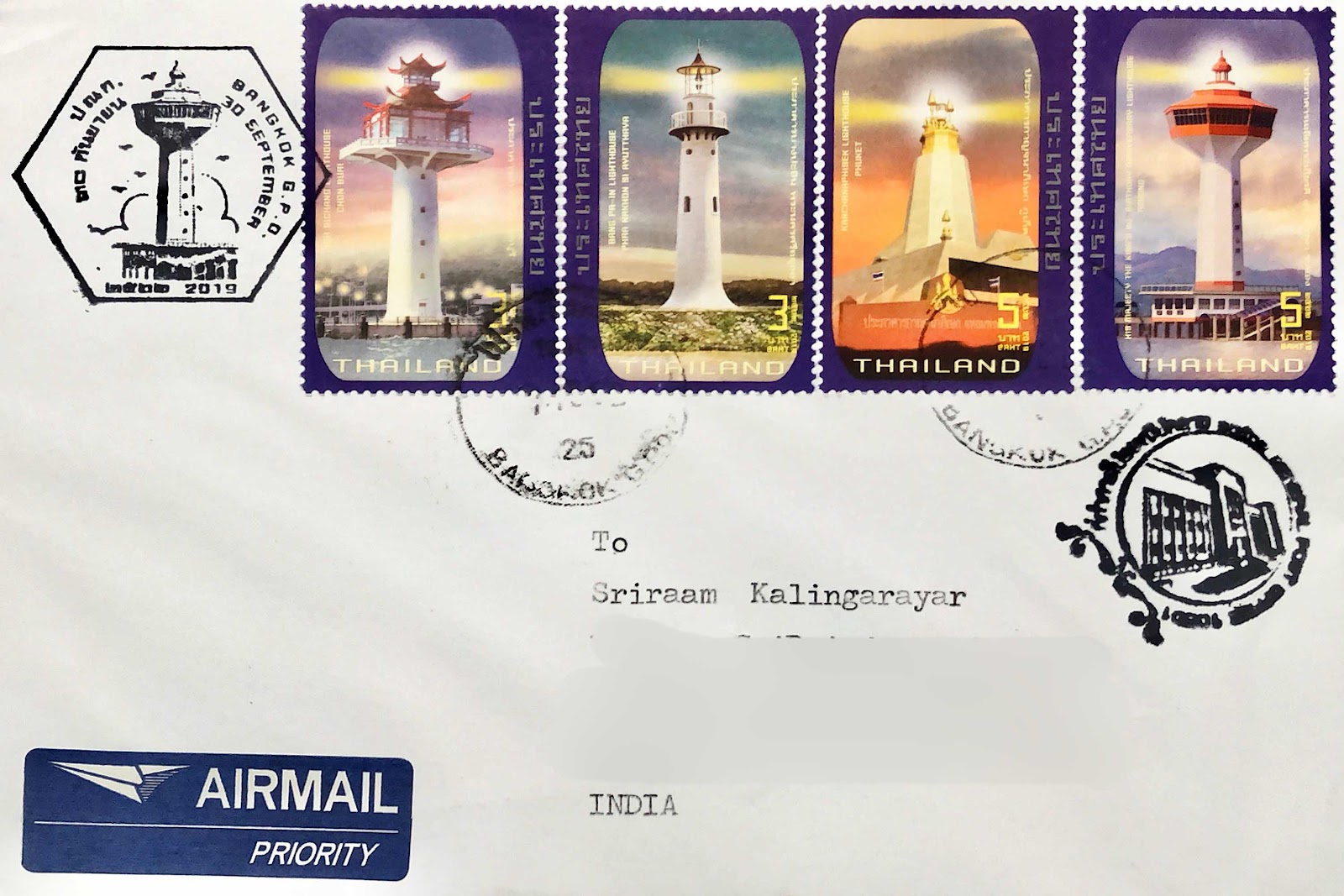
An FDC from Thailand 🇹🇭
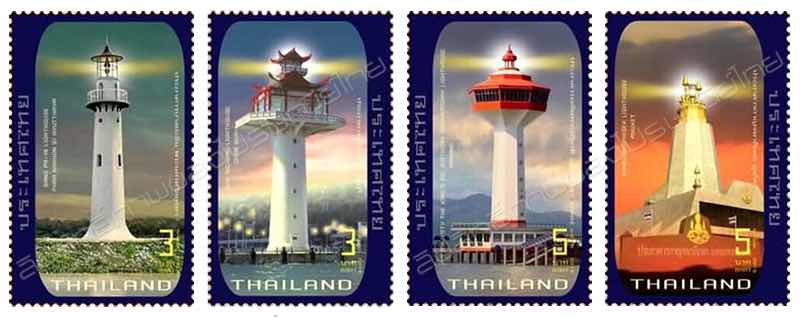
Lighthouses of Thailand
Date of issue : 30-09-2019
I am yet at a loss to find the details of each lighthouse !!


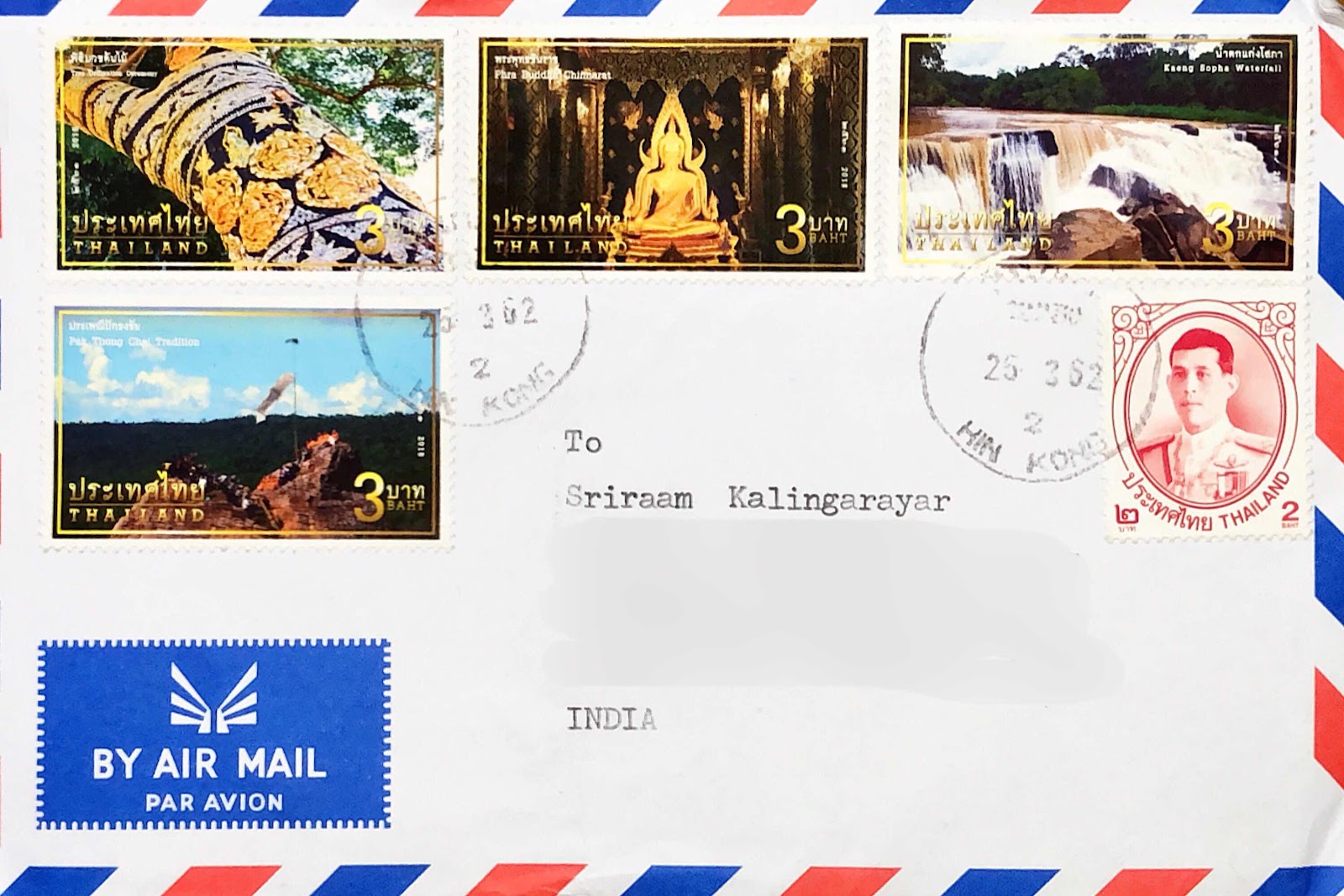


The temple is famous for its golden Buddha image named Phra Buddha Chinnarat, considered by many to be the most beautiful Buddha image in Thailand. It is one of the most highly revered images in the country, which makes the temple an important pilgrimage site for Thai Buddhists.
The temple was founded in 1357 by King Phaya Lithai, King of the Sukhothai Kingdom. The King ordered the casting of three large Buddha images to be enshrined in the newly constructed temple.
While the first two images came out perfect on the first try, the last image took three castings. When it was completed, it turned out to be the most beautiful of the three and was named Phra Buddha Chinnarat. The 375 centimeter high Sukhothai style image is in the subduing Mara posture.
In the early 17th century gold plating was applied to the bronze image. A distinguishing feature is the aureola, shaped like flames, that surrounds most of the image. Of the three images that were cast, today only the Phra Buddha Chinnarat remains in this temple, the other two are now in the Wat Bowonniwet in Bangkok.
The Buddha image is depicted on the provincial seal of Phitsanulok province.

Every year the Nakhon Thai District of Phisanulok Province organizes a big fair to celebrate and manifest the admirable unity of its people – the Pak Thong Chai tradition, which is held on waxing 14th of the 12th month. The residents hold a common belief that its origin dated back to the time Po Khun Bang Klang Tao was the ruler of Bang Yang (now Nakhon Thai ) . The benevolent ruler was honored and respected as being the Nakhon Thai hero.
In the past as soon as the 12th month arrived, the Nakhon Thai monks and the community leaders would decide at whose particular house they would gather to make the special, traditional ritual (white) flags for the merit-making Bun Pak Thong. Normally, it would be the house of someone skillful in weaving. Or it could be the house of the village head. The folks lent their hand doing the weaving job. They brought cotton yarns, made from their own trees, as common materials for the special flags. The weavers generally were the women, as in those days every woman could weave.
Each of the 3 flags measured a little over 2 meters. Nineteen wooden bhodi leaves were needed for 1 flag. The 3 flags were made by 3 different villages. The wooden bhodi trees were used to decorate the flag edges. Then a 1-foot bamboo tube was tied along one side of the flag to give it some weight support, as it was to be flown on the mountaintop.
Loud music from fiddles, gongs and drums all along the way was heard. The people also danced along – a lively and funfilled time it was. In the evening prior to the flag flying day, there was a religious ceremony, in which monks chanted some evening prayers.
Today the tradition is observed on a grand scale, and has become a cultural tourism attraction drawing people from Mueang Nakhon Thai district and subdistricts, as well as outsiders. The celebration lasts 10 days and nights, from waxing 13th to waning 7th in the 12th month.

The "ecology monks" are those actively engaged in environmental and
conservation activities and who respond to the suffering which
environmental degradation causes. A major aim of Buddhism is to relieve
suffering, the root causes of which are greed, ignorance, and hatred. The
monks see the destruction of the forests, pollution of the air and water,
and other environmental problems as ultimately caused by people acting
through these evils, motivated by economic gain and the material benefits
of development, industrialization, and consumerism. As monks, they believe
it is their duty to take action against these evils. Their actions bring
them into the realm of political and economic debates, especially
concerning the rapid development of the Thai economy and control of natural
resources.
Tree ordination ceremonies (buat ton mai) are performed by many participants in the Buddhist ecology movement in order to raise the awareness of the rate of environmental destruction in Thailand and to build a spiritual commitment among local people to conserving the forests and watersheds. Some large-scale ordinations have been carried out for publicity and public sympathy to make the government see the environmental impact of some of its economic development plans. Most tree ordinations are aimed at local areas, and villagers, through their participation in these ceremonies, signify their acceptance of this adaptation of a Buddhist ritual to sanctify the forest and thereby protect it. The regulations the monks establish limit their use of the forest, forbidding the cutting of any trees or killing of any wildlife within it.
Namtok Kaeng Sopha is a waterfall and tourist attraction in Wang Thong district of Phitsanulok Province in Thailand. Situated in Thung Salaeng Luang National Park on the Wang Thong River it is the largest waterfall in Phitsanulok. Kaeng Sopha is a tiered waterfall, shaped like a stairway, and it has been dubbed the Niagara Falls of Thailand. The torrents are very strong in the rainy season. The vapor rising in the area creates a vast rain-like curtain.Thanks Narong for this beautiful cover :) I wish I can visit Phitsanulok some time 🤞🏼




Vesak day (also known as Buddha Purnima or Buddha Day) is a national holiday observed in many Buddhist and Hindu countries, including Thailand. It is considered to be the most significant Buddhist holiday because it commemorates the three defining events in the life of Buddha- the birth, the enlightenment, and the passing away (“Buddhist Lent Day”, n.d). Buddha was born during the 6th century B.C and attained enlightenment at the age of 35, providing the tenets of Buddhism which he taught until his death at the age of 80 (“Buddha”, 2018) Buddhists believe he entered Nirvana, escaping all suffering and reincarnation (“Visakha Bucha Day 2018 and 2019”, n.d). All three defining moments land on the same month and date, known as the Vesak Full Moon day.
The holiday is celebrated in many different ways by Buddhists around the world. In Thailand specifically, it is named Visakha Bucha day. While it does not have a fixed day each year, it typically falls in May or June.
Vesak Day (issued 22-05-2018)
- Phra That Sri Jomthong in Chiang Mai
- Phra That Dot Tung in Chiang Rai
- Phra That Lampang Luang in Lampang
- Phra That Gate Kaew Chulamanee in Chiang Mai
Phrathat Jao Sri Jom Thong, is a temple in Jom Thong County. The legend says, it was probably built in somewhere around the 20th-24th Buddhist era, according to the art and architectural evidences within the temple. One of the things that make Phrathat Sri Chom Thong Temple so important is, this temple is the storage of a part of Lord Buddha’s relics. The legend also says that the Indian emperor Ashoka was the one who brough the relics to the temple. Not only that, Phrathat Sri Chom Thong Temple was also registered as a national historic site, along with many other temples in Chiang Mai. Moreover, this is a fortunate temple for those who were born in year of the rat.
Phra Maha Chinathat Chao (Doi Tung) or commonly known as Wat Phrathat Doi Tung is located on top of Doi Din Daeng. It was built in the reign of Phrachao Uchutarat, the 3rd King of the Singhanawat Royal Family. At the time. Phra Maha Kassapa presented to the King relics of the Buddha (a collarbone). The relics were then moved and kept on top of Doi Tung, previously known as Doi Din Daeng where the Milakku or Lua tribe resided. The King gave gold to the head of the tribe in exchange for an additional 3.000 square wa extension on each side of the land surrounding Phrathat. The temple was named after a sacred flag known as Tung in local dialect which was 7,000 square wa in length and put up at the temple by Phra Maha Kassapa. it relates to the belief that Phrathat is assigned to the Year of the Pig.
Phra That Lampang Luang is a fortified temple or wiang; it was built on top of an earth mound and is surrounded by high brick walls. In the early 18th century when Lampang was occupied by the Burmese, the invaders occupied the temple. It was later freed by a group of 300 local people led by a man named Thippachak, whose statue can be seen on the temple grounds. The highly revered Phra Kaew Don Tao Buddha image cast in the 16th century is enshrined in this temple, after it was brought here from nearby Wat Phra Kaew Don Tao temple. To get a good overview of the fortified temple complex atop the mound, hire a horse drawn carriage to take you around the temple.
Thanks Narong for this beautiful cover :)