Showing posts with label post. Show all posts

Tuesday, July 9, 2019

Modern Sea Mail

Even before the Victorian period, the primary medium in transporting mails from one country to another was through the Sea / ships . The sea mail postal services enabled people to correspond across the ocean.
Ship letter and sea mails were letters that were brought by a ship from one country to another and were stamped to indicate its passage.

But with the introduction of  aeroplanes and subsequently the development of Airmail, the transport of mails by sea started declining. Surface mails are still but rarely used. 

In modern world, there still exists post offices in ferries and ships that sail the waters of the Northern Europe. My interest in mails through these modern ships have been triggered after I received an array of postcards sent by a dear friend ! 


Schleswig-Holstein is the northernmost of the 16 states of Germany, comprising most of the historical duchy of Holstein and the southern part of the former Duchy of Schleswig. Its capital city is Kiel. 

MS Schleswig-Holstein was built in 2011 at the Neptun shipyard in Rostock. The keel was laid on 2 May 2011 and the transfer on 1 December 2011 in Rostock. The baptism took place on December 30, 2011 in Wyk. Since December 20, 2011, she connects the mainland port Dagebüll with Wyk on Föhr and Wittdün on Amrum. It is the 29th new construction of the shipping company since 1885.

The postmark indicates German Seamail and the route of the MS Schleswig-Holstein and the postcard also carries the cachet of the ferry.
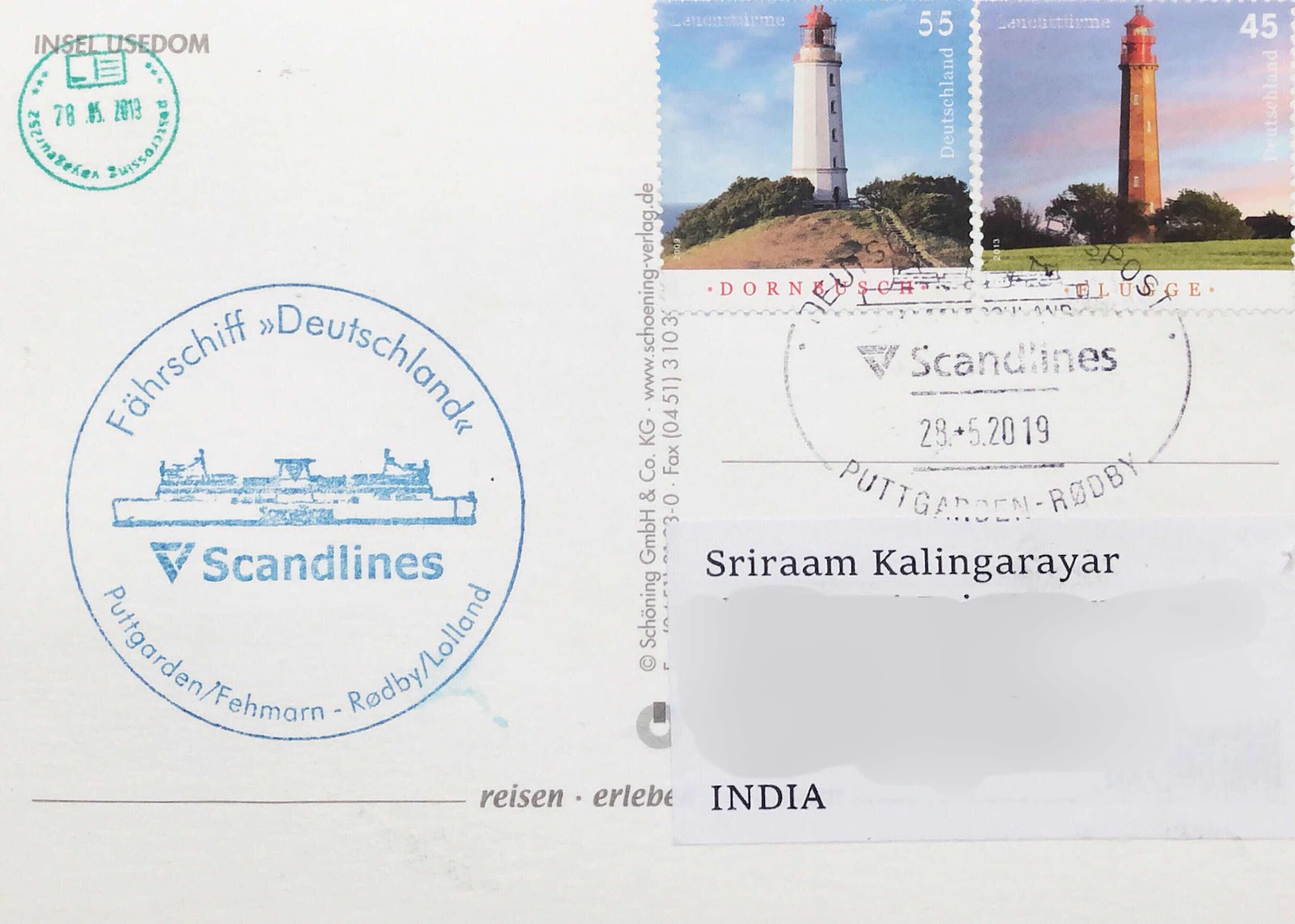


Scandlines is a ferry operator owned by a consortium consisting of First State Investments, Hermes Investment Management, and equity investor 3i Group. Scandlines operates two lines for passenger and freight in and between Denmark and Germany (Rødby–Puttgarden and Gedser–Rostock). 

This postcard has been mailed via the Scanlines ferry between Rødby ( Denmark ) to Puttgarden ( Germany ) with postage stamps of Germany. 
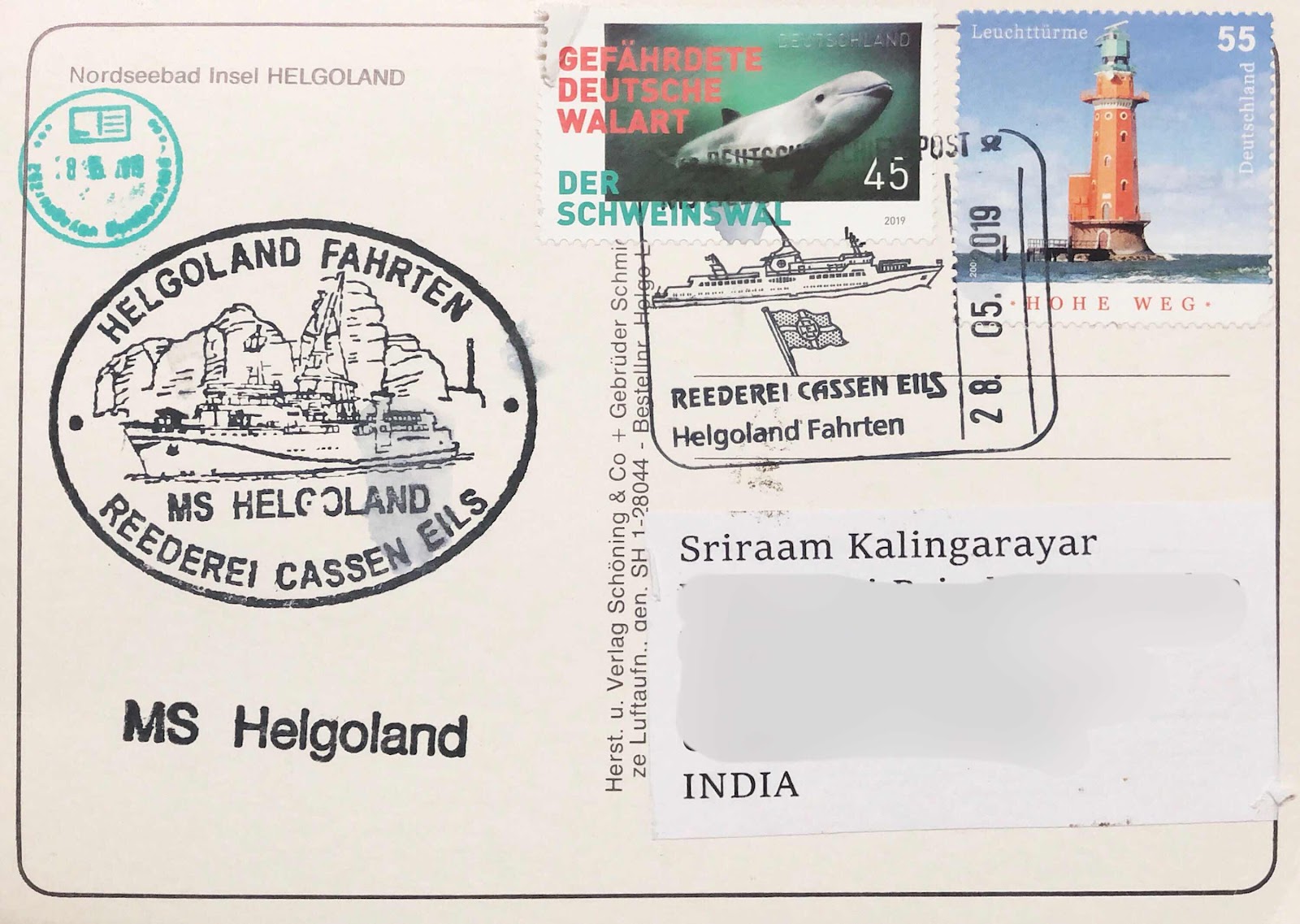


The Helgoland is a German seaside resort. The ship, which is built for around 31 million euros at the Fassmer shipyard, is operated with liquefied natural gas (LNG) and has been used by the shipping company Cassen Eils since December 2015 in the Heligoland service. The Helgoland is the first new German-flagged construction, whose internal combustion engines are operated with LNG, sailing between the ports of Cuxhaven and Helgoland.

The postmark indicates that it’s German Ship Post ( Deutsche Schiffspost ) 


MS Color Magic is a cruiseferry owned and operated by the Norway-based shipping company Color Line on its route connecting Oslo, Norway, with Kiel, Germany. She was built at Aker Finnyards Rauma Shipyard, Finland in 2007 and has been the largest ferry in the world ever since.

The postcard has been mailed with stamps of Norway 
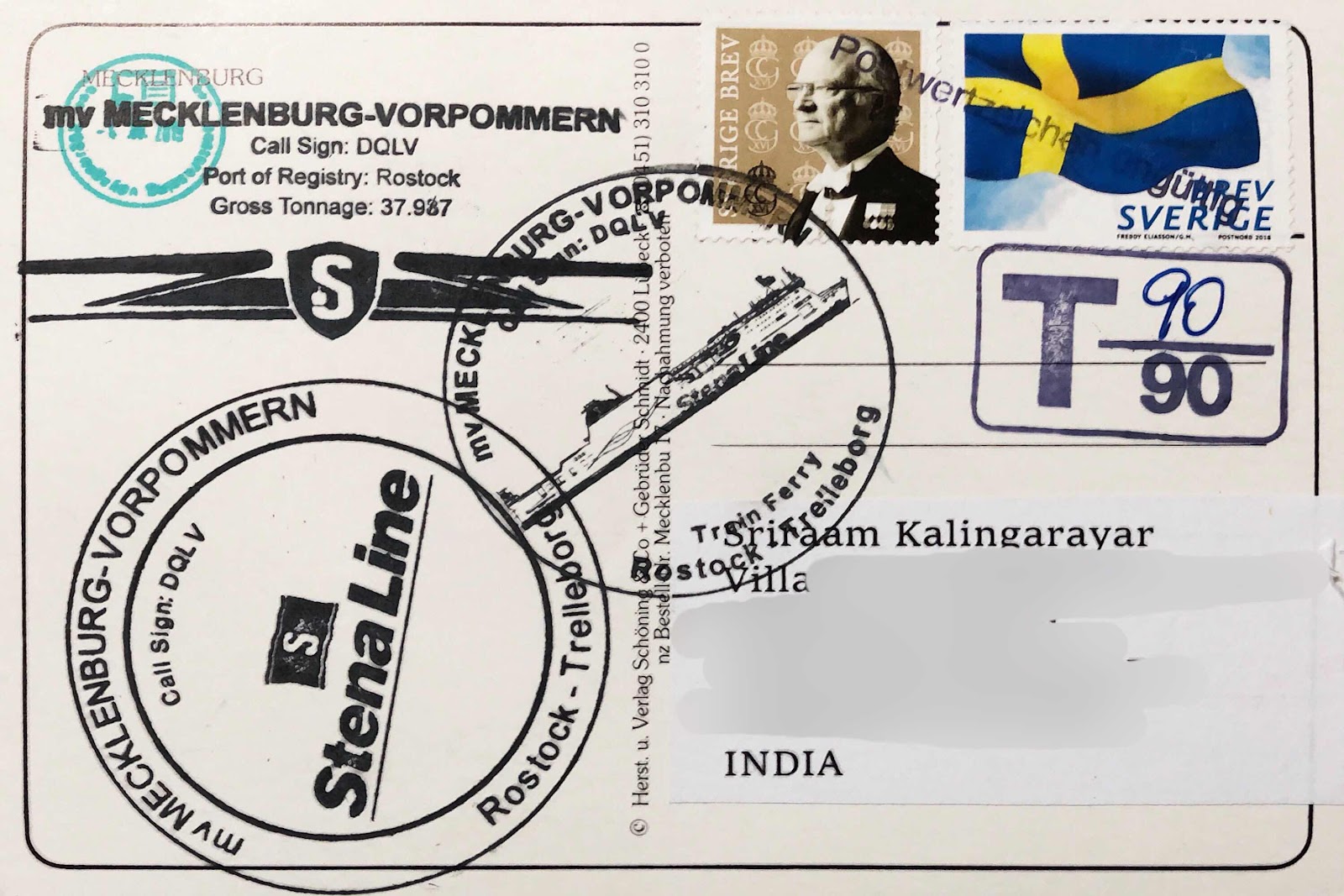


The state of Mecklenburg-Vorpommern was established in 1945 after World War II through the merger of the historic regions of Mecklenburg and the Prussian Western Pomerania by the Soviet military administration in Allied-occupied Germany. Mecklenburg-Vorpommern became part of the German Democratic Republic in 1947, but was dissolved in 1952 during administrative reforms and its territory divided into the districts of Rostock, Schwerin, and Neubrandenburg. Mecklenburg-Vorpommern was re-established in 1990 following German reunification, and became one of the Federal Republic of Germany's new states.

Two ferries are operated by Stena lines, Mecklenburg-Vorpommern and Skåne, operate on the route Rostock ( Germany ) – Trelleborg ( Sweden ) , with up to three departures per day. The port of registry for the ferry is at Rostock ( Germany ) 

The stamps of Sweden on the postcard has been defaced with the cancelation “ invalid postage” and a postage due postmark ( T )  has been placed with postage due of 90 cents ( the international Airmail postage of Germany ). Quite an interesting postcard with philatelic value :) 
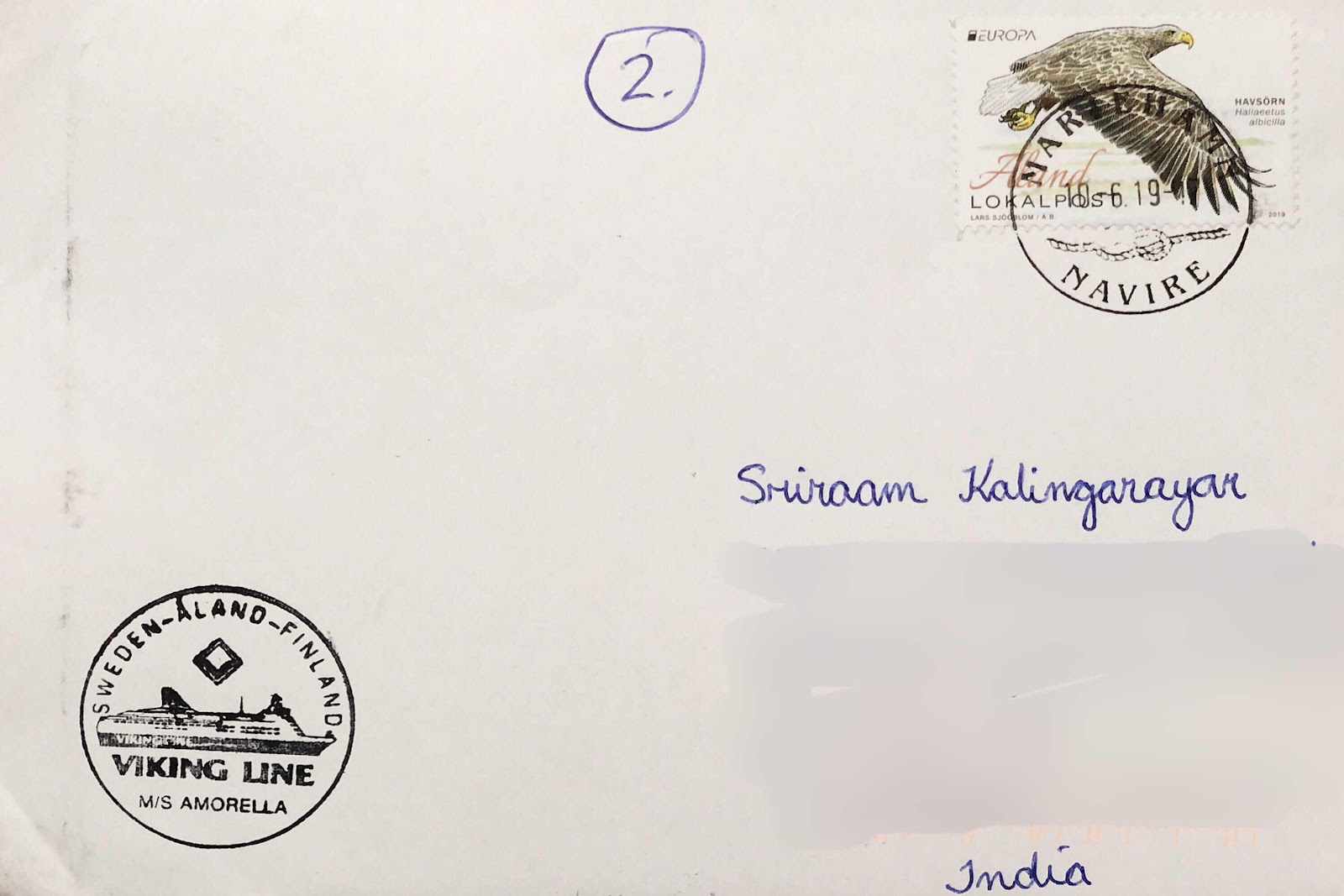


MS Amorella is a cruiseferry operated by the Finnish ferry company Viking Line on the route Turku–Mariehamn/Långnäs–Stockholm. She was built in 1988 by Brodosplit in Croatia, then Yugoslavia.

The cover with Åland Islands stamp has been postmarked with Mariehamn (navire - ship ) date  postmark 
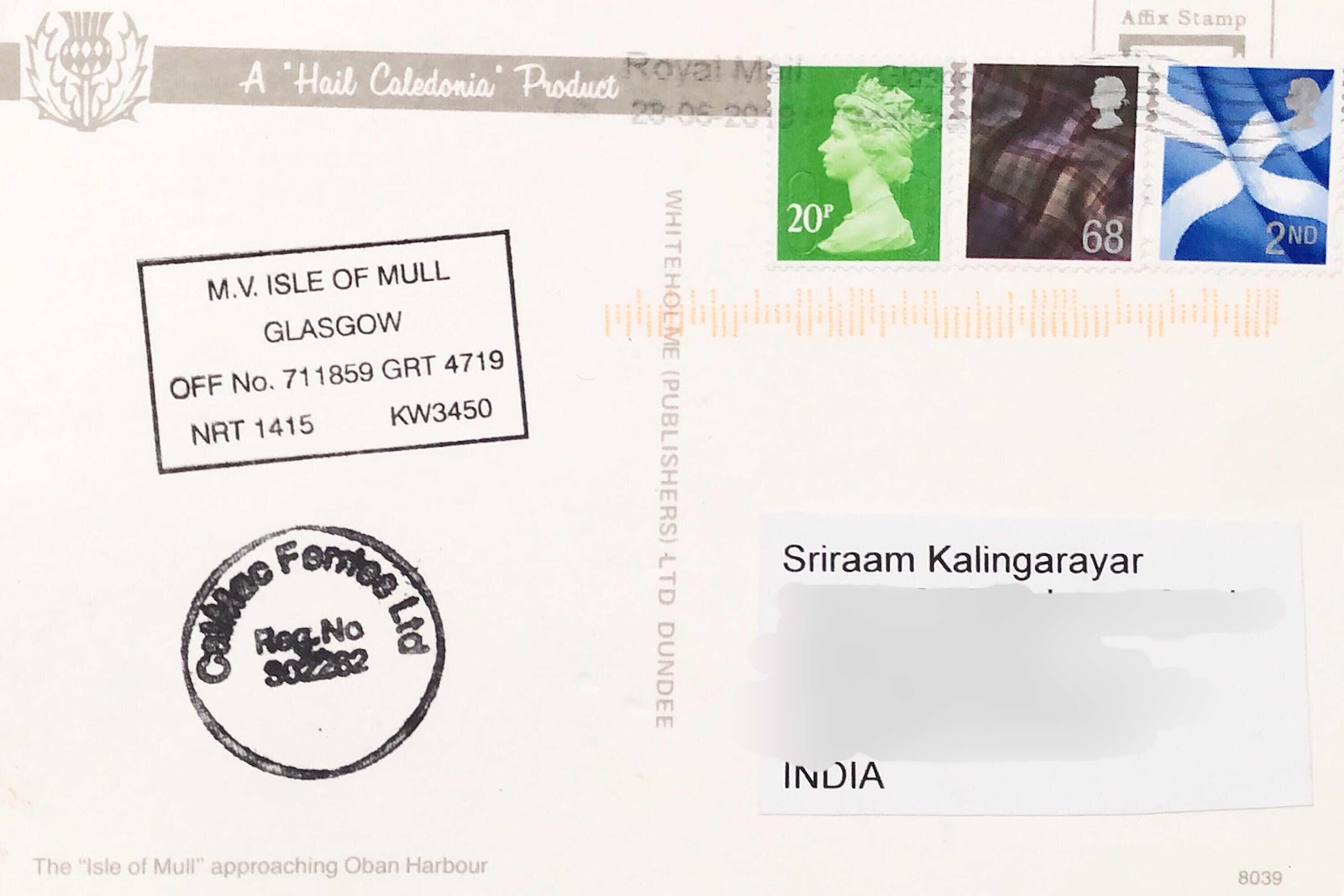


MV Isle of Mull is one of the larger Caledonian Maritime Assets Limited ferries operated by Caledonian MacBrayne from Oban on the west of Scotland. She has been ferrying since 1988. 


The MS "Adler-Express" will punctually, comfortably, and quickly take the passengers to Hallig Hooge and the islands of Amrum, Sylt, and Heligoland from Nordstrand/Strucklahnungshörn harbor. En-route, one can enjoy the unique island- and Hallig panorama, either on the open deck or through the generous panoramic glazing in any weather conditions.

Thanks Tom for these array of wonderful sea mail postcards :) 

Saturday, June 22, 2019

Private posts of Germany


Postcard No. 1 

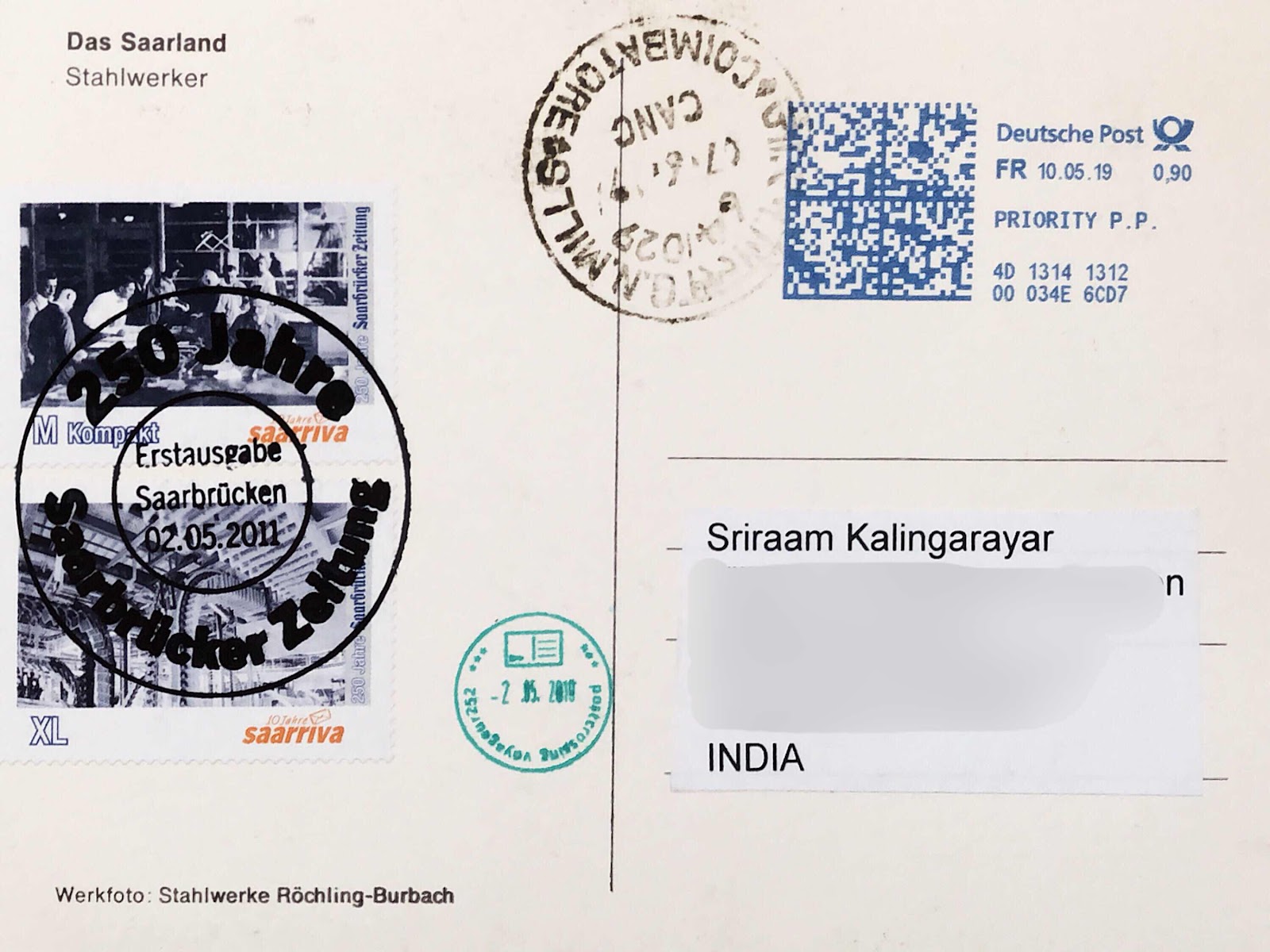
A postcard from Germany 🇩🇪 via Saariva post 

Saarriva is - as the name implies - a Saarland-based company based in Saarbrücken and a subsidiary of Saarbrücker Zeitung and Postcon, a business postal service provider from NRW (formerly TNT Post). The main delivery area is in the Saarland, but also in many other regions, post can be sent via Saarriva. The way there and the delivery is then again taken over by cooperation partners as in this case , the postcard has been sent by airmail to India by Deutsche Post ( with a meter cancellation on the top ) 


250 years of Saarbrücker Zeitung 
Date of issue : 02-05-2011

The Saarbrücker Zeitung (SZ) is a daily (except Sundays) newspaper published in Saarland, Germany. It was first published as a weekly journal in 1761 under the title Nassau-Saarbrückisches Wochenblatt (Nassau-Saarbrücken Weekly). After several changes in name and frequency, it appeared since 1861 under its current title. After the Saar Treaty in 1956, the Saarland state became its owner. It was privatized in 1969; the paper's major owner (56.1%) is the Holtzbrinck Publishing Group.

On the occasion of the 250th anniversary of the Saarbrücker Zeitung, saarriva launched its 3rd saarriva stamp collection with the name "250 Jahre Saarbrücker Zeitung" with its first day 02.05.2011. The motifs, all from the field of newspaper production, take the viewer on a breathtaking journey through the history of newspaper printing.


Postcard No. 2 

A postcard from Germany via CityMail Regensburg post ! 

The Deutsche Post has applied labels over the CityMail stamps and postmark when they sent the postcard via their system overseas ! So I deceived to carefully peel the label and look at the postmark ( I am not sure if it’s a good philatelic practice though ) 


CityMail Regensburg is a private mail service operating in Southern Germany- Bavaria.  Founded in 1999, the company has been a wholly owned subsidiary of M Das Medienhaus since 2002. More than 120 employees process about 30 million shipments per year, mainly from business customers in the region such as public authorities, companies from SMEs to corporations or healthcare organizations.


1175 years of City Roding 

Roding is a town in the district of Cham, in Bavaria, Germany, near the Czech border.

The postcard has been sent by airmail to India by Deutsche Post ( with a meter cancellation on the top ) 


I had earlier received a postcard via PostModern post of Dresden , Saxony -which uses Post NL for their international mail service ! http://travellingenvelopes.blogspot.com/2019/03/postmodern-dresden.html?m=0


A postcard from Germany via Nordbrief Kiel post ! 

Thanks Tom for these very interesting postcards showing an important aspect of German Postal system !! 


Monday, April 1, 2019

First International AirMail Service - UK


A ( postcard ) from UK ! 

An international British Air Mail Service was first proposed in July 1917. After much discussion and various trials carried out jointly by the RAF and the Royal Engineers (Postal Section) a regular air mail service was set up and began to operate between Folkestone and Cologne on the 1st March 1919. Its purpose was to provide troops of the British Army stationed in Germany with a fast mail service

To mark the centenary of this Air Mail Service BFPS has produced a commemorative cover published on the 1st March 2019.

The postcard is actually an FDC insert for the RAF centenary stamps .. Thanks Tom for arranging to send me this card with the beautiful postmark from the British Forces Postal Service ! 


Sunday, March 24, 2019

PostModern Dresden


A postcard from On- Board , the steamboat in Leipzig posted through PostModern Dresden. 

PostModern is one of the postal companies in Germany that issue their own, mainly self-adhesive stamps. PostModern also regularly issues special stamp editions accompanying regional events in Dresden and Saxony..


I had received a cover earlier with the stamp showing the panorama of Dresden across the Elbe river. The state of Saxony is a landlocked federal state of Germany, bordering the federal states of Brandenburg, Saxony Anhalt, Thuringia, and Bavaria, as well as the countries of Poland and the Czech Republic. Its capital is Dresden, and its largest city is Leipzig.


Since 1999, the Media Logistics GmbH from Dresden as a local mail service provider in the greater Dresden area. The enterprise is a joint venture of the Dresdner pressure and publishing house GmbH & CO. KG and the Fiege logistics AG. The focus of business activities is on the distribution logistics for newspapers and postal services. 


Since 2006, the private mail service of Media Logistik GmbH in Saxony has been operating under the PostModern brand. PostModern collects the mail from business customers, franks it and delivers it the next day. Private individuals can also use this service provider via their red mailboxes. The delivery of letters and parcels is possible for private individuals since 1 January 2011 throughout Germany. For business customers, it continues to be restricted to the ZIP codes 0 and 1 as well as 38, 39, 98 and 99. This covers almost the entire territory of the new Länder and Berlin. One of the cooperation partners is Ostsächsische Sparkasse Dresden, which sells stamps and mailboxes from PostModern are installed at their branches.
In fiscal 2012, Media Logistik GmbH employed 154 people, generated revenues of 43.8 million euros and a net income of 3.0 million euros


On July 8, 1836, King Frederick Augustus II of Saxony granted the newly founded company privilege for steamship transport in the Kingdom of Saxony. 180 years later, steamboat shipping in the Elbe Valley is still in full steam and PostModern Dresden honored the anniversary with a special stamp.


The other stamp depicts the Lighthouse of Moritzburg. The lighthouse in Moritzburg is an inland lighthouse in Saxony. The staffage building (Folly) was built in the late 18th century as part of a backdrop for trailing naval battles (Naumachie). It is the only lighthouse built in Germany for this purpose and at the same time one of the oldest internal lighthouses in the Federal Republic.


The historical background, however, was the Battle of the Dardanelles of 1770 between the fleet of Russian Tzarina Catharine the Great and the Turkish fleet, which ended in victory for the Russians over the »arch enemy«, which was honoured throughout Europe.When the sea battle was enacted, the two-masted frigate of the royal society, the pier as well as the so-called Dardanelles between the Great Lake and the Canal were armed with little canons which could fire fireworks-like ammunition.


Thanks Tom for this nice postcard showing the steamboat on Elbe - and the on-board postmark , the private post stamps and postmarks ! 

It is also interesting that the international Mail posted through PostModern Dresden is handled by PostNL ( Netherlands ) and you can find the meter cancellation of PostNL at the top !! 

Monday, March 18, 2019

100 years ... German republic and German AirMail


A cover from Germany 🇩🇪 with stamps and postmark depicting important events immediately after World War One.


With the end of the First World War and the start of the November Revolution, Chancellor Max of Baden announced the abdication of the German Emperor Wilhelm II on 9 November 1918. He also appointed Friedrich Ebert as his own successor as Chancellor. 

In October 1918, the constitution of the German Empire was reformed to give more powers to the elected parliament. On 29 October, rebellion broke out in Kiel among sailors. There, sailors, soldiers, and workers began electing Workers' and Soldiers' Councils (Arbeiter und Soldatenräte) modeled after the Soviets of the Russian Revolution of 1917. The revolution spread throughout Germany, and participants seized military and civil powers in individual cities. The power takeover was achieved everywhere without loss of life.

The elections for the National Assembly on 19 January 1919 were the first elections in Germany after the introduction of women's suffrage.The legal voting age had been lowered from 25 to 20 years. Together, these changes raised the number of eligible voters by around 20 million. The turnout rate was 83%, a slightly lower percentage than in the last Reichstag elections in 1912, but a much greater absolute turnout due to the expanded suffrage. Among women the turnout was 90%.


100th anniversary of Women Suffrage 
Issue - January 2019

The Postmark : 

The first regular national airmail connections under German administration were established at the end of World War I at the eastern front in Russia and the Baltic provinces. The history of German civil airmail started on February 5, 1919. Airplanes took off twice a day from Berlin-Johannisthal to transport postal consignments—initially newspapers but letters from the second day—from the Berlin to the location of the convention of the constituent Weimar National Assembly in Weimar. At first this airmail facility could only be utilised by delegates, who had moved to Thuringia's capital at that time, to avoid the revolutionary situation in Berlin. A few months later this airmail route was made available to the public. 

In the following years, airmail connections quickly developed in Germany, as well as in the whole of western Europe and the USA.


Saturday, March 16, 2019

Liechtenstein Post - 200 years and still going strong


A prepaid postcard - postal stationary - from Liechtenstein 🇱🇮 - issued for the 200th Anniversary of the Austrian post collection centre at Balzers. ( 200 jahre K.K Briefsammelstelle Balzers ). 


Liechtenstein’s postal history begins when the mail collection station was opened in Balzers on 1 September 1817 by the Austrian postal administration.

Until the end of World War I, Liechtenstein was closely tied first to the Austrian Empire and later to Austria-Hungary; the ruling princes continued to derive much of their wealth from estates in the Habsburg territories, and spent much of their time at their two palaces in Vienna.

The Austro-Hungarian Empire established its state post in 1770 and operated all over Central Europe including Poland , Czech regions , Austria and Hungary , Italy etc .... Liechtenstein is known to have been on the mail route from Milan to Lindau in the 15th century as two postal stations were established at Balzers and Schaan to handle the volume of mails. 

In 1817, Austria opened the collecting office (Postampt) in Balzers. Before 1867, the territories under the control of the Habsburg monarch in Austria used the hyphenated kaiserlich-königlich ( k.k ). 

The Balzers collection centre was closed two years later because it couldn't compete with the Milan route but, in 1827, the Austrians reopened it. The new post office was integrated into the rest of the Austrian postal network so Liechtenstein was treated as a part of Austria. A second Austrian office was opened at Vaduz in 1845.

This is why the first Liechtenstein stamp that appeared in 1912 bore the inscription “K.K. Österr. Post im Fürstentum Liechtenstein”, i.e. Imperial and Royal Austrian Post in the Principality of Liechtenstein. Although eight years later the postal service became independent and was named “Fürstlich Liechtensteinische Post”, it remained under Austrian administration until 1921 when the treaty on the handling of the postal, telephone and telegraph services in Liechtenstein by Switzerland entered into force. 

The postal horn with a value of 100 CHF has been pre printed on the postcard with an image showing the imperial emblem of Austria- Hungary Empire on the walls of the collection centre of Balzers. 

The postcard has been uprated with another interesting stamp that commomerates the 100 years of diplomatic relations with Austria and Switzerland. 


The special stamp “Vienna and Bern” (face value: CHF 2.20) focuses on the theme of the diplomatic missions of Liechtenstein set up in Switzerland and Austria in 1919 for the first time
Issue date: - 04-03-2019

Lawyer Emil Beck (1888-1973) was the representative at the Liechtenstein legation in Bern until 1933. He played a part in various state treaty negotiations between both countries. According to parliamentary records, the closure of the diplomatic mission in Switzerland was attributed to the country’s financial situation. At the request of Liechtenstein's government in 1919, Switzerland safeguards Liechtenstein's interests and citizens abroad. The two form a common economic and monetary area (Liechtenstein has used the Swiss franc (since 1920) and has had a customs union (since 1924) with Switzerland with open borders (though both are now also party to the Schengen Agreement). The countries also have a common patent system. Switzerland is empowered to enter into treaties on Liechtenstein's behalf if Liechtenstein is not represented at the treaty negotiations; this power has most often been exercised with treaties involving customs duties or procedures.

Prince Eduard of Liechtenstein (1872-1951) was also a legal scholar and represented Liechtenstein’s interests from 1919 to 1921 as an envoy in Vienna. At the time, the aim was to get Liechtenstein out of the difficult situation it found itself in as a result of the First World War and to ensure that the country was recognised as being neutral and independent.

Today, Liechtenstein- the fourth smallest landlocked country in the world , sharing boundaries with two countries - has a very harmonious relationship with both its neighbours. The principality which was completely under the influence of Austria till the end of WW1, aligned itself with Switzerland after 1919. Inspite of the economic disaster post WW2 , the principality has managed to emerge as the country with the highest GDP per person in the world. 

Also - Austria has been a major player in the development of postal services all over Central Europe. 

The postmark : 


The postmark on the postcard is the pictorial postmark from Balzers !! And on the first day of issue of the stamp ;) 


Balzers

Thanks Tom for this beautiful postcard ! Your postcards teach me more history than any history book :) 

And yes, the Balzers postmark makes the postcard more special than a first day postmark of the stamp would !!!

Thursday, March 14, 2019

Polish Post - 450th Anniversary


An FDC issued in 2008 for the 450th anniversary of Poland Post - uprated with 2014 stamps from Poland 🇵🇱 

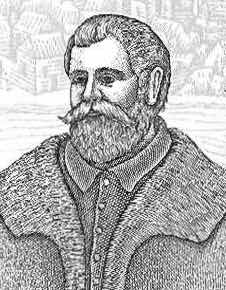
The minisheet bears the images of  Prospero Provono , Sigismund II Augustus, Sebastiano Montelupi with the image of Kraków city in the background. Let’s dig into the history behind this image and the subtle influence of Italy behind Poland Post. 


The earliest record of a postal system in Poland is, from the year 1387, of merchants who organised a private system and introduced horse riders to replace foot letter carriers. 
              
                       King Sigismund Augustus 

On 17 October 1558 Sigismund II Augustus appointed Prospero Provano, an Italian merchant living in Kraków, to organise a postal service in Poland. He was paid 1,500 thalers per annum by the royal treasury to run the postal service. He merged all the private postal services into a single postal service. Royal mail and mail from some monastic orders was carried free. All other mail was paid for.

Prospero Provono, initially in the service of Queen Bona, dealt mainly with the trade of textiles and wine. He became a Cracow canteen and, being a leaseholder of royal estates, led Wieliczka to great prosperity. He was the starost of Będzin, and together with the Jew Joachim from Brest-Litovsk, he built saltworks in Będzin and nearby Ujejscy. 

The death of the queen Bona Sforza ( an ambitious and energetic member of the powerful House Of Sforza that ruled the Duchy of Milan and the second wife of  King Sigismund I Old )  in 1557 was the factor that influenced the emergence of the Polish Post, because King Sigismund II Augustus had to maintain permanent and regular correspondence with Italy in order to collect his inheritance. The King needed frequent contact with the Italian principalities of Bari and Rossano, which were part of the Bona 's inheritance. 

Provano received from the king a tenement at Floriańska St. 14, which has been preserved and is still standing today, it houses the hotel "Pod Różą".

Hotel Pod Róża - Kraków 
Above the entrance there is a beautiful Latin inscription:  "Let this house stand until the sea ant dries, and the turtle does not roam the world" . This tenement house was " the postal and receiving point of the Royal Mail. 

Privilege of Zygmunt August for Prosper Prowan
Establishment of the Krakow - Venice mail and nomination of the noble Prosper Prowanper, Sigismund August, etc. - In this letter, we hereby announce to you that - keeping an eye on our own and our subjects' convenience that both us and Italy could more conveniently send letters as also other things to do there - we arrange permanent communication, that is, we establish a so-called post, i.e. spaced horses Krakow - Venice, running constantly during marked periods, years and days. In order that the post could be fulfilled even better and more efficiently, we appoint Prosper Prowanper, Our Mediator in Krakow, whose nobly born Proteus, whose righteousness and agility are well known to us: we are managing this letter so that everyone will recognize him and consider him the director and guardian of this post. At the same time, we give full and unlimited power to manage and manage this post together with the prisoners, as well as to administer and fulfill everything that belongs to the office of the director and guardian of the post.


Provana, however, started a conflict with the Thurn und Taxis family, who controlled postal communications in Austria, Hungary and Italy since 1516. This resulted after four years in the withdrawal of the benefit granted to Provan. The Polish King decided to transfer the Polish postal system to the Taxis family and did this on 11 July 1562. Christopher Taxis received the same annual salary as Provano.

The postal service of the Taxis was composed of the 
Italian post (Cracow-Vienna-Venice) 
Lithuanian Post (Cracow-Warsaw-Vilnius). 

The postal messenger left Cracow each Sunday morning, arrived in Vienna on Wednesday and then left for Venice, where he arrived after seven days journey. 

The courier set off to Lithuania each week on Wednesday, in order to arrive in Vilnius after a week's journey. Therefore, the letter from Cracow to Venice took 10 days and from Cracow to Vilnius 7 days.

 
Christopher Taxis ran the system as a commercial venture and because of his extravagance the postal system deteriorated. Sigismund II Augustus terminated the contract with the Taxis family after two years. 


On 9 January 1564 Peter Moffon was appointed postmaster general by the Polish King. Moffon, another Italian merchant living in Kraków, was given the postal contract for five years. Because of a significant regress in the regularity of this post, on 15 June 1569 he was replaced by Sebastiano Montelupi, who was one of the richest Cracow bourgeois. 


Montelupi's Royal Post was responsible for delivering the parcels to the king once a week, when the ruler was residing in any location within the Crown of the Kingdom of Poland, or once every three weeks when he was residing in Lithuania. The route to Venice was operated every 15 days and to Vilnius every 17 days. For his services Montelupi received 1300 thalers yearly and used the payments for private consignments. Furthermore, the royal carriages were also at his disposal. 


The Italian House - Montelupi Kamienica 

The Montelupi Kamienica located in Cracow at Rynek Główny no. 7 was the principal office of the post office. When it was operating as a postal centre stagecoaches to Venice departed from here.


When King Sigismund Augustus died in 1572, Montelupi continued the service at his own expense for two years. The public postal service then ceased for a period of some 11 years, although a system reserved to royal use was rebuilt from 1574 onwards.

On 29 January 1583 Sebastiano Montelupi and his nephew (and adopted heir), Valerio Montelupi, were given a contract to run the postal service for five years. When giving the contract the King, Stefan Batory, introduced a uniform postal rate of 4 groszy per letter not exceeding 1 łut (about 12.66 grams) for any distance in Poland. This was the first uniform postal rate to be introduced in the world. Sebastiano Montelupi died in 1600 aged 84 and Valerio Montelupi continued to run the postal service till his death in 1613.

A postal system that was created to maintain a link between Kraków and Milan - almost 4 centuries ago ! 


Thanks Wojtek- I am glad the cover finally made it to me - after taking a circuitous route ;) 

Monday, February 25, 2019

Antalya and postal buildings of Turkey


A cover from Turkey 🇹🇷 


Perga or Perge was an ancient Anatolian city in modern Turkey, once the capital of Pamphylia Secunda, now in Antalya province on the southwestern Mediterranean coast of Turkey. Today, it is a large site of ancient ruins 15 kilometres (9.3 mi) east of Antalya on the coastal plain. An acropolis located there dates back to the Bronze Age.

The cover has been posted from Antalya with the city postoffice postmark ! 

The other stamp is part of the 2016 definitives - on PTT buildings in Turkey .. but I am unable to find out which postal building the stamp depicts !! 

Thanks Vera for the cover ! 

Update : 28-02-2019
I found from Mrs. Vera about the second stamp !! 


The stamp is part of the 2016 definitives on postal buildings. This particular stamp depicts Mardin postal office building. 


Mardin is a city and multiple (former/titular) bishopric in southeastern Turkey. The capital of Mardin Province, it is known for the Artuqid (Artıklı or Artuklu in Turkish) architecture of its old city, and for its strategic location on a rocky hill near the Tigris River that rises steeply over the flat plains. Mardin has often been considered an open-air museum due to its historical architecture. Most buildings use the beige colored limestone rock which has been mined for centuries in quarries around the area.

Mardin post office building 

Thanks again Vera ! 

Tuesday, January 8, 2019

Horizon labels of UK


A cover from UK with a Horizon label ! 

Horizon label is an adhesive postage label that is a type of variable value stamp. The labels were introduced in the United Kingdom in 2002 as part of the computerisation of the counter services of the post office network of Royal Mail using the Horizon System.

The first labels were large plain labels composed purely of text but later labels are of a gold colour with a Machin head and a repeating pattern of the words ROYALMAIL in order to prevent forgery.

  • 14 February 2002 - First labels used in about 1000 post offices. Plain white with straight edges.


  • 30 April 2002 - Security slits added to prevent reuse.
  • August & September 2002 - Labels rolled out nationally.
  • April 2009 - Labels with simulated perforations appear.
  • 8 June 2009 - First gold labels appear featuring the Machin head for Special Delivery only from the Camden High StreetP.O., London. Gold labels gradually introduced nationally.


  • 20 April 2010 - First labels with dual English-Welsh language inscriptions available from Welsh post offices.


  • 23 August 2010 - Straight-edged labels reintroduced first at Old Street then nationally.
  • 29 September 2011 - Value Added Tax codes added.
  • May 2015 - "Pre-cancelled" labels trialled at the Europhilex exhibition with corner "Single Use Only" wording. Colour changed back to white. Subsequently used nationally
  • .

  • September 2015 - Barcode added to the design.

The labels received a frosty reception from philatelists initially as they were seen as replacing postage stamps, but as they have become more complex and more stamp-like, collectors have warmed to them and they have now become a popular collecting specialism in the U.K. and an established part of modern British postal history.

The Service Indicators / tariff codes include :-


2L
2nd Class Letter
1L
1st Class Letter
1st
Letters for the Blind - to 100grams
2LG (2LL)
2nd Class Large Letter
1LG (1LL)
1st Class Large Letter
2PK
2nd Class Packet
1PK
1st Class Packet
BL
BFPO 1st Class Letter
BLG (BLL)
BFPO Large Letter
BPK
BFPO Packet
BF
BFPO Parcels
FF
Forces Freepost
FP
Fully Paid
PE
Parcel Economy International 
PS
Parcel Standard International 
RSF 
Recorded Signed for
SD
Special Delivery
SP
Standard Parcel
A
Airmail
AAX (AX)
Airsure
SU
Surface Mail
 

The one used on this cover must be the Europhilex version - with the corner “ single use only” wording. The covers could make an interesting collection on modern postal history ! 


For more information - http://deltastamps.com/Fact10.htm


Update - 19-01-19


Another cover with Horizon label - marked
 A - international standard 
And also L in the corner 

With a Q code image on the label ! 

Update : 13-04-2019


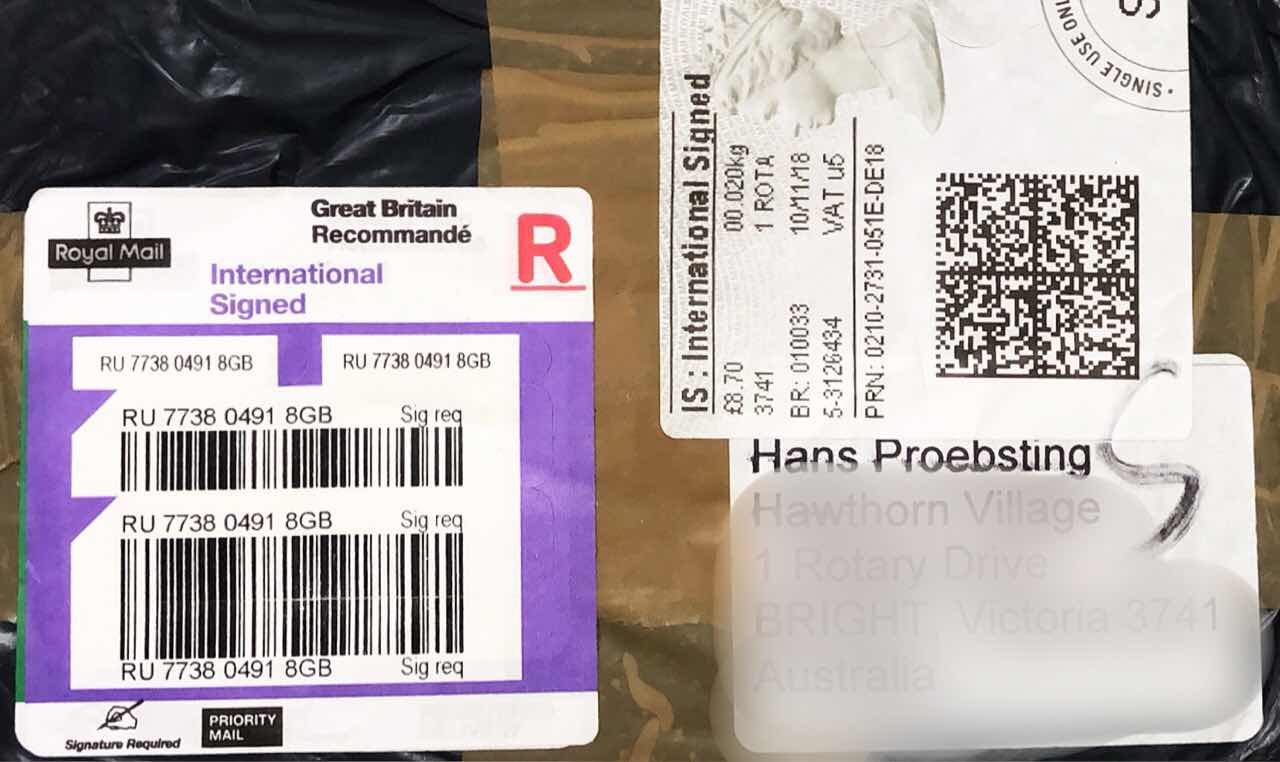
A horizon label with 
IS - International Standard
And S on the corner 
With a Q code image on the label !