Showing posts with label Joint Issue. Show all posts

Tuesday, February 12, 2019

Ice hockey


A cover from USA 🇺🇸 with ice hockey stamps 


Ice hockey is a contact team sport played on ice, usually in a rink, in which two teams of skaters use their sticks to shoot a vulcanizedrubber puck into their opponent's net to score points. The sport is known to be fast-paced and physical, with teams usually consisting of six players each: one goaltender, and five players who skate up and down the ice trying to take the puck and score a goal against the opposing team.

Ice hockey is most popular in Canada, central and eastern Europe, the Nordic countriesRussia and the United States. Ice hockey is the official national winter sport of Canada.[1] In addition, ice hockey is the most popular winter sport in BelarusCroatia, the Czech Republic, FinlandLatviaRussiaSlovakiaSweden, and Switzerland.

Ice hockey is believed to have evolved from simple stick and ball games played in the 18th and 19th century United Kingdom and elsewhere. These games were brought to North America and several similar winter games using informal rules as they were developed, such as "shinny" and "ice polo". The contemporary sport of ice hockey was developed in Canada, most notably in Montreal, where the first indoor hockey game was played on March 3, 1875. 

The stamps are a Joint Issue between USA and Canada. The stamps picture a vintage player representing the game’s past set against a snowy background. One player is wearing a contemporary uniform and using modern equipment, and the other is wearing vintage garb and using old-fashioned equipment. The two vertically stacked stamps in the souvenir sheet, which are arranged to mirror each other, are identical to those sold also as a pane of 20. “The History of Hockey” appears in the bottom left corner of the sheet under the flags of the United States and Canada.

The other stamp is the USA forever stamp for Diwali ! 

Monday, February 4, 2019

Vietnam India joint relations


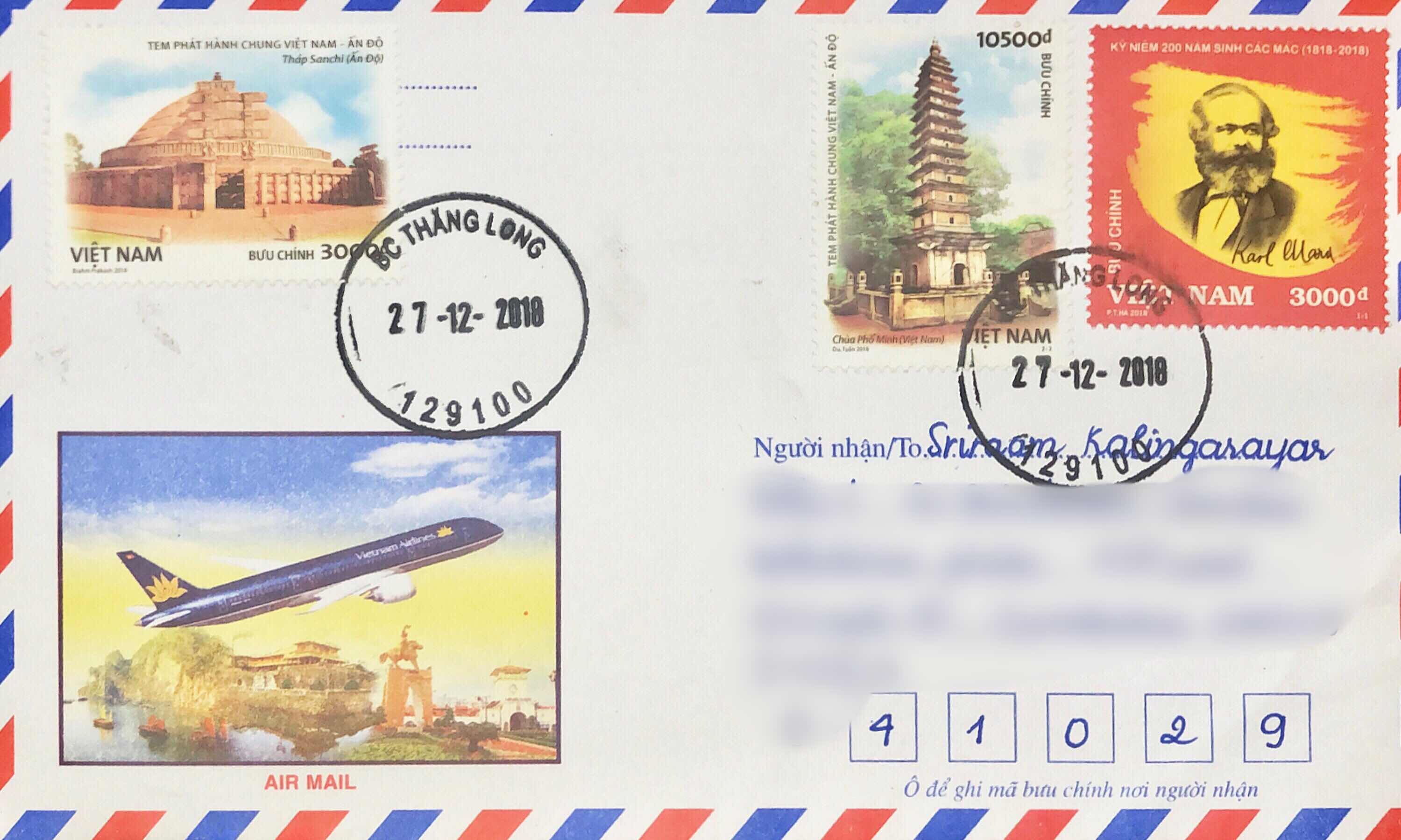
A cover from Vietnam with Karl Marx stamp and the India - Vietnam Joint Issue stamps 

The civilizational relationship between India and Viet Nam spans over 2000 years. Monks, traders and people from both countries have interacted over centuries. The intense cultural exchanges have enriched the cultural diversity of the region. India and Viet Nam enjoy good relations and have established bilateral cooperation mechanisms. The relations between the two countries are marked by strong trust, mutual understanding and convergence of views on various international issues and the regional security situation in Asia.

In recent times, political contacts have strengthened as reflected in several high-level visits by leaders from both sides. Trade and economic linkages continue to grow. Viet Nam is an important regional partner in South East Asia. India and Viet Nam closely cooperate in various regional forums such as ASEAN, East Asia Summit, Mekong Ganga Cooperation, Asia Europe Meeting (ASEM) besides UNand WTO.

India and Viet Nam have emphasized that enhancing bilateral economic engagement is a strategic objective. The bilateral trade is growing at a healthy pace.

In 2017, the two countries have celebrated the 45th Anniversary of the establishment of diplomatic relations and the 10th Anniversary of Strategic Partnership. The theme for the joint issue is Ancient Architecture, depicting Sanchi Stupa in the Indian stamp and Pho Minh Pagoda in the Viet Nam stamp. The Sanchi Stupa and the Pho Minh Pagoda are architectural landmarks of their respective countries and are tied by the common thread of Buddhism.
Sanchi Stupa:

  • The Great Stupa at Sanchi is one of the most important Buddhist monuments. Located at Sanchi town, Madhya PradeshIndia, this Stupa is the oldest stone structure in India that was built during the Mauryan period. Originally commissioned in the third century B.C. by Emperor Ashok, this huge hemispherical dome with a height of 54.0 ft consists of a central chamber where the relics of Lord Buddha are placed. Four ornamental gateways facing four directions and a balustrade surrounding the Stupa were later added in the first century B.C. Enlisted as a UNESCO World Heritage Site since 1989, it is counted among the best conserved ancient Stupas of central India.
  • The present hemispherical edifice is double in diameter of the original brick structure built by Ashoka, consisting of the relics of Lord Buddha. A chatra that is an umbrella like structure made of stone crowned the hemispherical brick structure that was surrounded by a wooden railing. A sandstone pillar, inscribed with Edict by Ashoka as also with ornate spiral Brahmi characters from the Gupta period resembling conch shells referred as Shankhalipi or ‘shell-script’ by scholars, was erected in the site. While the lower portion of it is still grounded, the upper portions are kept under a canopy. During the Shungadynasty, expansion of the Stupa, nearly double its original size with a more flattened dome was undertaken using stone slabs that entirely covered the actual brick Stupa. Three superimposed umbrella-like structures were built to crown the dome. It symbolized the Wheel of Law or dharma. A high rounded drum that can be reached through a double staircase became the seat of the dome enabling one to circumambulate the sacred dome.
Pho Minh Pagoda:

  • Pho Minh Pagoda is located 4 km north of Nam Dinh City and 94 km south of Hanoi, the Capital city. The pagoda was originally built during the Ly Dynasty of Viet Nam and later expanded in 1262 during the Tran Dynasty. It was a place for high-ranking mandarins and the aristocracy of the Tran Royal Court to worship and lead their religious life.
  • The architecture and decorations of the pagoda are characteristics of the Tran Dynasty’s times: lotus flower pond, lotus-flower decorations at the foot of the pillars, the Tran-styled dragon sculptures, the stone candle holders. Specially, a 13 story-tower named Pho Minh Tower in the shape of a lotus, 19 meters high, was built just in front yard of the pagoda in 1305. The base and the tower’s first floor were constructed with flagstones and the upper floors were built with bricks. On top of the tower, there is a gourd-shaped decoration which is kind of talisman to catch the elite energy from the universe. The tower is believed to connect the Earth and the Universe. Pho Minh Pagoda is mostly visited by the Vietnamese Buddhist Pilgrims and tourists, especially in festival times.


Monday, December 3, 2018

Israel and the World - part 5


Fifth cover from Israel with the joint issue stamps 

1. Israel - Poland joint issue 

2018- This year Israel celebrates 70 years of independence and Poland – 100 years since regaining independence after decades of occupation by its neighbors.
The Polish and the Jewish peoples have a long and rich common history with many peaks but also valleys, until the Holocaust effectively ended the large Jewish presence on Polish soil.

Since Poland was liberated from Communism, it has proven to be one of Israel’s closest friends. Relations between the two countries are blossoming in all fields – culture, trade, technology and tourism. In the past year, mutual tourism increased by tens of percentage points, a phenomenon that strengthens the friendship between the states and the peoples even more. This joint stamp issue, which is not the first between Israel and Poland, along with innumerable cultural collaborations, are a testament to the increasing partnership and close relations.

During the course of the many meetings Israeli diplomats attend in various places throughout this large country, we are met with immense friendliness and frequently great curiosity regarding Israel, which allows us to organize numerous cultural and technological activities. Poland is also extremely friendly to Israel in the political realm – both in supporting and cultivating our mutual relations as well as in international forums. The most prominent example of this is Poland’s abstention during the United Nations vote to condemn the U.S. decision to recognize Jerusalem as the capital of Israel.

2. Israel - USA Joint Issue 


The stamp art features a Hanukkah menorah created using the technique of papercutting, a Jewish folk art, by artist Tamar Fishman. Behind the menorah is a shape that resembles an ancient oil jug representing the miracle of the oil that burned in the candelabra in the Holy Temple in Jerusalem after its sacking and recapture for the eight days necessary to resupply. Additional design elements include dreidels and a pomegranate plant with fruit and flowers.

The stamp also is meant to celebrate 70 years since the establishment of diplomatic relations between Israel and the United States, Israel Post said in a statement.

The new stamp design was launched simultaneously in the Touro Synagogue in Newport, Rhode Island, the oldest synagogue in the United States, and at the American Center in Jerusalem.

Five beautiful covers with Israel Joint issues . Thanks Mikhail ! 

Sunday, December 2, 2018

Israel and the World- part 4


The fourth cover of Israel Joint issues 

1. Israel - Uruguay Joint Issue 
The South American and Israeli postal companies chose a drawing by the artist Jose Gurevich of the Matriarch Sarah when she was told by angels that she would have a son. The Jewish-Uruguayan artist had created a series of biblical drawings in honor of his mother who contracted cancer. The image on the NIS 2 stamp designed by Rinat Gilboa testifies to the deep cultural and religious roots of the Jewish People. Uruguay was the first country to recognise Israel and the stamp honours the 65 years of their friendship . 


2. Israel - Estonia Joint Issue 

Interestingly, the diplomatic ties between Estonia and the region of Palestine have a longer history. The Republic of Estonia appointed an Honorary Consul to the British Governor of Palestine in 1929 and the Honorary Consulate of the Republic of Estonia was located at Litwinsky House. Today, Estonia and the State of Israel consider themselves similar in many ways. Both countries are proud of being modern young states ready to accept the technological and security challenges of the 21st century. Both countries are recognized world leaders in the IT and cyber security realm  and both boast an impressive number of start-up companies. The contacts and cooperation between Estonia and Israel, in their private as well as public sectors, are expanding to include the whole realm of economic and technological innovation.

A Jewish presence in Estonia was first recorded in 1333, but their numbers remained small until the 18th century. The Republic of Estonia granted Jews cultural autonomy in 1926 – the first country in Europe to do so. This cultural autonomy was renounced in 1940 as a result of the Soviet occupation and restored after Estonia regained its independence in 1991.

Today there is a smaller, but very dynamic and active Jewish community in Estonia, numbering approximately 2000 members. There is a synagogue (reopened in 2010) and Jewish Cultural Center in Tallinn as well as a Jewish school, kindergarten and social center.

The Litwinsky House is an outstanding architectural building in Tel Aviv. It was built by Yaakov Elhanan Litwinsky (1852-1916), a well-known businessman who immigrated from Odessa. Before that he had purchased one of the original sixty-six lots in Ahuzat Bayit, the nucleus of the future Tel Aviv. The house he built with his family at 22 Achad Ha’am Street was one of the most impressive homes in the new neighborhood.

3. Israel - Russia Joint Issue 


Christian tradition calls the village of Ein Karem, located to the west of Jerusalem, the "City of Judea". The Virgin Mary visited Ein Karem while carrying her unborn child Jesus and according to the New Testament, she met her cousin St. Elizabeth there, while she was also pregnant with her son, John the Baptist. On the hillside above the village there is a large, magnificent gold-domed church which is part of the Russian convent complex that was built in honor of that visit. Construction of the convent and the church began in the 19th century, initiated by the head of the Russian religious mission to the Holy Land. These buildings reflect the deep Russian religious involvement in Eretz Israel toward the end of the Ottoman Period, when tens of thousands of devout Russians made the pilgrimage to the Holy Land every year.
 In 1871, Archimandrite Antonin Kapoustin, head of the Russian religious mission, purchased a large plot of land in Ein Karem with funds contributed by devout businessmen and noblemen. He planned and built a modest church at the center of the complex and invited wealthy women who wished to live out their lives in the Holy Land to build houses there. Those houses were subsequently inherited by the community, thus over time a few dozen buildings were incorporated into the Russian Gorny ("mountainous") Convent. In 1910, Leonid Sinzov, one of the heads of the Russian religious mission after Kapoustin, decided to build a new larger and grander church up on the hillside, which he planned to call "The Church of the Holy Trinity". In order to build the church, Sinzov borrowed large sums of money from various parties. He also expected to receive contributions to complete the construction. But these plans came to an abrupt halt when WWI broke out in 1914. Contact with Russia was severed and the Russian representatives, who were declared to be enemy subjects, were deported to Egypt and construction of the church stopped. After the war, it was impossible to continue the construction due to significant debts and the severance of ties with the anti-religious Soviet Union.
 The roofless church stood abandoned for decades, until the early 21st century, when construction recommenced. The church was completed in 2007 and named the "Cathedral of All Russian Saints". In recent years, this typical Russian-looking church is visited by increasing numbers of tourists and pilgrims and it represents Russia's deep religious bond to Jerusalem.

To be continued ... 


Israel and the World - part 3


A third cover from Israel with Joint Issue stamps 

1. Israel - Portugal Joint Issue 


The Jewish people have ancient ties to Portugal, but the Portuguese Jewish community experienced dramatic changes beginning in the early 15th century: expulsion, forced conversion and the Inquisition. In 1989, a formal apology from the Portuguese people was issued to the Jews and in 1996 the Decree of Expulsion was nullified on the 500th anniversary of its issuance. 

During WWII, many Jews passed through Portugal, mostly immigrating to other countries and later also to Israel.Israel recognized four Portuguese "Righteous Gentiles". The most well known is Aristides de Sousa Mendes, who issued visas to thousands of Jews while serving as the Portuguese consul-general in Bordeaux, France during the Holocaust.

This stamp is issued to mark 40 years of friendship between the two countries. 

Common Bottlenose Dolphin. (Tursiops truncatus) belongs to the family Delphinidae and is most commonly found in tropical to temperate oceans, mainly in the shallow waters of the continental shelf, where water depths are up to 200 meters. Mature dolphins range from 2-4 meters in length and weigh between 150-650 kgs. 

2. Israel - Germany Joint Issue 


Fifty years ago on May 12, 1965, as the agreement establishing German-Israeli diplomatic relations was signed, no one could have imagined that Israel and Germany would be the close allies they are today. Relations between Israel and Germany developed against the background of Nazi Germany's role in the genocide of the Jewish people during the Holocaust. Two statesmen, David Ben-Gurion, one of the founders and first Prime Minister of Israel, and Konrad Adenauer, the first Chancellor of the Federal Republic of Germany made it possible, against all odds, for the two countries to engage in direct exchange. The way was paved mainly by the civil societies on each side. They built the important bridges between people in both countries. 

In 2003, the White City of Tel-Aviv was proclaimed a UNESCO World Heritage Site thanks to its many buildings designed in the international style known as Bauhaus architecture. 

The Bauhaus school was founded in Germany after WWI. Its goal was to provide an innovative solution suitable to the high social standards of that time. New construction technologies enabled by the industrial revolution were utilized by the school.The fifth Aliyah (1933-1939) brought numerous wealthy people to Eretz Israel, along with many construction professionals. The population also increased greatly, creating a severe housing shortage. 

The new style of building provided a solution to this problem, as well as a way to differentiate "Hebrew" construction from both the local Eastern style and the classic European style that raised extremely difficult memories.

The international architectural style inspired by the modern movement provided unique local solutions suited to the geographical area as well as to the spirit of the place. The "German" Aliyah left its mark on more than the architecture itself. Many construction-related German words, such as "spachtel" (putty knife), are used in Hebrew to this day.

The stamp features the Beit Bruno building located 3 Strauss St. which was built by architect Zeev Heller in 1935.The stamp tab features the logo marking 50 years of diplomatic relations between Israel and Germany. The logo was designed by Ariel Wollek of Israel and Ticha Matting of Germany - winners of a competition initiated by the Israeli and German Foreign Offices.


To be continued ... 

Israel and the World - part 2


The second cover from Israel with four sets of Joint Issue stamps Of Israel 

1. Israel - Greece Joint Issue 

The stamp features Haifa Port as represented by a typical freighter and cranes, with the Baha'i Gardens on the slopes of Mt. Carmel in the background; and the Port of Thessaloniki as represented by a typical cruise ship and cranes, with the ancient white tower on the beach in the background. 

The stamp tab features the 25 Years of Diplomatic Relations between Israel and Greece logo, designed by graphic artist and illustrator Kelly Matathia Covo. Both are modern democratic states, Mediterranean neighbors, with common values representing the proud independence of two ancient nations. The two countries have forged a multidimensional partnership with wide-ranging cooperation in all fields reflecting our peoples' shared history, close cultural ties and common interests.

2. Israel - Spain Joint Issue 

The Bridge of Strings is a cable stayed bridge built at the entrance to Jerusalem as part of the municipal light rail project. It was designed by Spanish architect Santiago Calatrava. The bridge allows the light rail to cross from Jaffa Road to Herzl Blvd. and also serves as a pedestrian bridge. It was designed as a modern gate and a new symbol of the city of Jerusalem. The bridge is 360 meters in length, weighs 4500 tons and utilizes some 10 kilometers of suspended cables. The angled mast on the side of the bridge is made of special steel and soars to a height of 118 meters. It is connected to the pavement below by 70 cables. These cables bear the full weight of the bridge with no supporting beams whatsoever. The inspiration for the design comes from a verse in the Book of Psalms, 150:3: Praise Him with harp and lyre. According to Calatrava, "I felt that David's city should have a bridge that resembled a harp or a violin, the instrument that he played".

Construction of the bridge began in 2005 and was inaugurated on June 25, 2008. Santiago Calatrava, born in 1951, is a Spanish engineer and architect whose style is original and unique. He has designed public buildings and suspension bridges around the world. He integrates his vast engineering knowledge and his architectural skills into his works to create aesthetic structures inspired by nature. Calatrava's unique style is characterized by the color white, extensive use of cables, arches, steel beams, stone and glass to create a "transparent" effect and organic shapes.

3. Israel - Philippines joint issue 

The relations between Israel and the Philippines are founded upon two events that were morally and politically significant for the Israeli and Philippine peoples. 

The first event was the decision made by Manuel L. Quezon, the President of the Philippines at the time, to open his country's gates to Jewish refugees from Germany and Austria on the eve of WWII, which stood in stark contrast to the conduct of the "enlightened" nations during that period. 

The second event was that the Philippines was the only Asian country to vote in favor of Israel at the United Nations on November 29, 1947 during the historic decision that led to the establishment of the State of Israel and the recognition thereof by the family of nations. 

This friendly relationship is also related to the fact that Israel is the Holy Land and the land of the Bible, which greatly affects the Philippino people. According to a study conducted by the Anti-defamation League, the Philippines is one of the only countries in the world that has virtually no anti-Semitism, a fact that is in line with the two countries’ joint history. Israel has a significant Filipino population, whose contribution to the welfare for incurable patients and the disabled is greatly appreciated.


The Open Doors Monument is located at the center of the Memorial Garden in the city of Rishon LeZion. It was dedicated in 2007 and marks the assistance the Philippines provided to Jewish refugees during WWII. 

In the late 1930's most countries of the world closed their doors to Jews who were being persecuted by the Nazi regime. During this difficult period Philippine President Manuel L. Quezon agreed to issue 10,000 immigrant visas to European Jews. Some 1,300 Jews utilized these visas to immigrate to the Philippines. Many of them worked in the cigarette factory founded by the Freidar family in Manila and lived in blocs that President Quezon had built especially for them. 

The monument, created by Philippine artist Mr. Jun Yee, consists of three doors in graded sizes symbolizing the courage and humanity of the Filipino people in welcoming the Jewish refugees. The triangular shape of the open doors represents the triangle on the Philippine flag and the triangles that comprise the Star of David. This integration of triangles is a symbol of the close friendly ties that exist between the Philippine Republic and the State of Israel. 

The concrete floor below each door features an impression of a pair of feet crossing the threshold into the open door. These footprints belong to George Levinstein, a Jewish refugee who arrived in the Philippines in 1939, Max Weissler, who arrived in the Philippines in 1941 at age 11 and Dorilis Goffer, a 10-year old Filipino Israeli girl who is the granddaughter of Holocaust survivors. Her footprints represent the continued friendship between the two countries. 

4. Israel - Croatia Joint Issue 

Crown Anemone (Anemone coronaria)
From the moment the first Anemones bloom, it is impossible to ignore them, even from a distance. Anemones face the sun and follow it throughout the day. This flower acts like a concave mirror, concentrating the sun's rays and warming the stamens and stigmas at its center to as much as ten degrees above the temperature in the surrounding area. This heat speeds up the germination of the pollen grains, thus reducing the chance that they will be washed away by rain.
In many places the Crown Anemone blooms in numerous different colors, mainly white, blue and purple, in addition to red. All have the same fragrance.
Surprisingly, the wind is responsible for most of the pollination and all of Israel's Crown Anemones belong to a single genetic population, with no significant differences. In the Southern part of the country grow only red flowers, which are more resistant to the drier conditions. 


Croatian Iris (Iris croatica Prodán)

The only place in the world in which the Croatian Iris grows is on the forested limestone hills in western Croatia. It was not defined scientifically until 1962 and by 2000 it was declared by the Croatian Academy of Arts and Science as Croatia's national flower. This plant is known as Perunika in honor of Perun, the highest god of the pantheon and god of thunder and Lightning in Slavic mythology. Legend has it that Perunika only grows where lightning has struck the ground. A special folk dancing festival named for the Iris is held in May, when the flowers bloom. The Croatian Iris is used to create especially beautiful hybrids with other iris species and its beauty and resistance make it a popular garden plant.
The rhizomes contain essential oils and fragrant resins. Powder prepared from the rhizome is used in folk medicine, as well as in the preparation of perfumes and for other cosmetic purposes.


To be continued ... 


Israel and the World


First cover with three joint issues of Israel 

1. Israel - Vatican Joint Issue 


While the visit by Pope Francis to Israel in May 2014 was officially described as a pilgrimage to the Holy Land, he participated in two events bearing both historic significance and importance for the future: the Pope met with the Orthodox Patriarch Bartholomew I (to mark the 50th anniversary of the historic meeting between Pope Paul VI and Patriarch Athenagoras  I); and placed a wreath at the gravesite of Theodor Herzl, the founder of modern Zionism, another indication of the strengthening ties between Israel and the Vatican, and between Judaism and the Catholic Church.

2. Israel- Bulgaria Joint Issue 


Israel and Bulgaria share a strong, unique historical bond.The joint efforts of the Bulgarian people, the Church and the Parliament saved the Bulgarian Jewish community during WWII, adding an exceptional human dimension to the diplomatic relations between the two countries.

The stork is connected to human habitats and in Europe it signifies the arrival of spring and symbolizes hope. Some 600,000 storks migrate through Israel's skies twice a year, among them probably all of Bulgaria's storks.

3. Israel - Malta Joint Issue 


Israel and Malta issued a joint postage stamp to mark 50 years of diplomatic ties between the countries and recall the shared history of the Order of the Knights Hospitallers that began in Jerusalem in the Middle Ages. 

The Order of the Knights Hospitallers was founded in Jerusalem in the 12th century and established its center south of the Church of the Holy Sepulchre. During the Crusader period the knights, who were also known as the Order of the Hospitallers of St. John of Jerusalem, were tasked with aiding Christian pilgrims to the Holy Land by providing protection and medical services. After the defeat of the Crusaders at the 1187 Battle of Hattin, the Hospitallers retreated to Acre where they built halls and community centers, some of which are still standing today.

In the later Middle Ages, facing the advancing Muslim armies, the Hospitallers were forced out of Acre and were granted the island of Malta by Holy Roman Emperor Charles V, founding their own state on the island with its capital at Valletta. The Hospitallers built a hospital overlooking the port of Valletta. The surviving building is now used as a conference center.

To be continued .. 


Thursday, November 29, 2018

Japan and India relationship


A beautiful cover from Japan 

The sender, knowing that I like joint issues offered to send me the Japan India joint issue stamp of 2002 . 


Japan and India issued joint issue stamps in 2002. But the stamps were completely different. While India issued stamps depicting dances of India and Japan , Japan issued a single stamp showing Tajmahal . 
The stamp was issued as part of the Japan - South Asia series on 12-04-2002 along with Japan - pakistan , Bangladesh and Srilanka Joint Issue stamps. 

The other stamp is a very old stamp - 1975 - honouring their majesties visit to USA. 

The stamp features the Japanese flag - which represents the land of the rising sun - and cherry blossoms - a flower that is native to Japan and was offered as a gift to USA. 

Thanks CS for the cover - I love how it depicts Japan and India and speaks so much of their rich heritage :) 


Update : 17-June - 2019


Another cover from Japan with the Tajmahal stamp and a cachet too !! 

This is the first cover I received from Japan after the emperor abdicated on May1, 2019 and the crown prince succeeded him as the Emperor. So the era also is reset and the Japanese year is counted as Year 1 from May 1, 2019 ( which can be seen in the brown postmark ) 

Monday, October 8, 2018

Presidential palaces


A cover from Singapore with the Singapore - India joint issue stamps . 


Date of issue - 24-November-2015
Designer - Wong Wui Kong

The joint issue stamps features the presidential palaces of both countries. 

Istana - Singapore 


The Istana is the official residence and office of the President of Singapore. Meaning "palace" in Malay, it is where the President receives and entertains state guests. The Istana is also the working office of the Prime Minister of Singapore.The 106 acres (0.43 km2) estate was once part of the extensive nutmeg plantation of Mount Sophia. In 1867, the British colonial government acquired the land and built a mansion to be the official home of the British governor. 


When Japan invaded in 1942, deliberate shelling destroyed the small ceremonial guns on the steps of Government House and left the building and its grounds in a state of ruin.During the occupation, the house was occupied by Field Marshal Count Hisaichi Terauchi, commander of the Japanese Southern Army, and Major General Kawamura, commander of the Singapore Defence Forces.The building continued to be used by governorsof the newly created Crown Colony of Singapore. When Singapore attained self-rule in 1959, the building was handed over to the Government of Singapore.


The building was extensively renovated between 1996 and 1998 to add more space and modern day conveniences. It has a tropical layout like a Malay house, surrounded by statuesque columns, deep verandahs, louvred windows and panelled doors to promote cross-ventilation. The central three-storey 28-metre-high tower block dominates the building.

Rashtrapati Bhavan - India 


Rashtrapati Bhavan is the official home of the president located at the Western end of Rajpath in New Delhi, India. Rashtrapati Bhavan may refer to only the 340-room main building that has the president's official residence, including reception halls, guest rooms and offices, also called the mansion; it may also refer to the entire 130-hectare (320 acre) Presidential Estate that additionally includes huge presidential gardens (Mughal Gardens), large open spaces, residences of bodyguards and staff, stables, other offices and utilities within its perimeter walls. In terms of area, it is one of the largest residences of a head of state in the world.


This decision to build a residence in New Delhi for the British Viceroy was taken after it was decided during the Delhi Durbar in December 1911 that the capital of India would be relocated from Calcutta to Delhi. When the plan for a new city, New Delhi, was developed after the Delhi Durbar, the new palace for the Viceroy of India was given an enormous size and prominent position.The British architect Edwin Landseer Lutyens, a major member of the city-planning process, was given the primary architectural responsibility. Consisting of four floors and 340 rooms, with a floor area of 200,000 square feet (19,000 m2), it was built using 1 billion bricks and 3,000,000 cu ft (85,000 m3) of stone with little steel. 


On 26 January 1950, when Rajendra Prasad became the first President of India and occupied this building, it was renamed as Rashtrapati Bhavan – the President's House.


India and Singapore share long-standing cultural, commercial and strategic relations, with Singapore being a part of the "Greater India" cultural and commercial region. More than 300,000 people of Indian origin live in Singapore. Singapore had always been an important strategic trading post, giving India trade access to the Far East. Singapore is the 8th largest source of investment in India and the largest amongst ASEAN member nations. India’s main exports to Singapore in 2005 included petroleum, gemstones, jewellery, machinery and its imports from Singapore included electronic goods, organic chemicals and metals. More than half of Singapore’s exports to India are "re-exports" – items that had been imported from India. India has become Singapore's 4th biggest tourist destination.  (Since early 2016 it has come to light that Singapore quietly backtracked on its commitment to CECA and has blocked Indian IT professionals seeking work visas. In response, India has put on hold further liberation of trade agreed under CECA for this flagrant violation by Singapore.)


Thanks Madhan for this envelope and the stamps !