Showing posts with label # Estonia. Show all posts

Thursday, November 8, 2018

Struve Geodetic Arc - Estonia


A cover from Estonia. 

Almost a month ago , I received a postcard from Belarus with a very mundane picture on the postcard. It has just some map on it and a cemetery kind of image adjacent to it , and I just put it aside. After a couple of days, I just googled about it and found that it was the map of Struve Geodetic Arc . 


 The Struve Geodetic Arc is a chain of survey triangulations stretching from Hammerfest in Norway to the Black Sea, through ten countries and over 2,820 km, which yielded the first accurate measurement of a meridian.

The chain was established and used by the German-born Russian scientist Friedrich Georg Wilhelm von Struve in the years 1816 to 1855 to establish the exact size and shape of the earth. At that time, the chain passed merely through two countries: Union of Sweden-Norway and the Russian Empire. The Arc's first point is located in Tartu Observatory in Estonia, where Struve conducted much of his research.
Measurement of the triangulation chain comprises 258 main triangles and 265 geodetic vertices. The northernmost point is located near Hammerfest in Norway and the southernmost point near the Black Sea in Ukraine. This inscription is located in ten countries, the most of any UNESCO World Heritage.


In 2005, the chain was inscribed on the World Heritage List as a memorable ensemble of the chain made up of 34 commemorative plaques or built obelisks out of the original 265 main station points which are marked by drilled holes in rock, iron crosses, cairns, others.

Friedrich Georg Wilhelm von Struve (Russian: Василий Яковлевич Струве, trans. Vasily Yakovlevich Struve; 15 April 1793 – 23 November [O.S. 11 November] 1864) was a German-Russian astronomer and geodesistfrom the famous Struve family. He is best known for studying double stars and for initiating a triangulation survey later named Struve Geodetic Arc in his honor.


The Tartu Observatory (Estonian: Tartu Observatoorium) is the largest astronomicalobservatory in Estonia. On January 1, 2018, Tartu Observatory joined again to Tartu University, observatory is now an institute of university. It is located on the Tõravere hill, about 20 km south-west of Tartu in Nõo Parish, Tartu County. The old Tartu Observatory located in Tartu city centre, is known internationally for its connection to Friedrich Georg Wilhelm von Struve and the Struve Geodetic Arc, of which it is the first reference point.


The cover is posted from Tartu and shows the Kvartali Keskus ( a region inside Tartu city ) postmark ! 

Wednesday, October 17, 2018

Cars of Estonia


An envelope from Estonia with the minisheet on Tallinn Monte-Carlo electric marathon 2018.


Tallinn was one of the starting points for the Monte Carlo rally in 1930–1939; as of 2011, the legendary competition is driven by electric cars. 2018 marks the first time that the electric car marathon follows the route from the Tallinn–Monte Carlo rally, which was held in the 1930s and was driven along the Baltics Sea coast and through France.
The competitions are organised in two categories: among teams of universities from six countries (these teams will be using the electric car Nissan Leaf EV) and in the so-called free class which accepts owners of electric cars of various makes. The marathon is driven through 10 countries, with stage finishes in 30 cities and the final finish is on the square in front of the Prince’s Palace of Monaco.
The marathon of electric cars is a unique competition on European roads. All team members have to achieve the same race time as the referee’s car, which starts 10 minutes before the participants at each stage of the competition. If a regular rally can be called a battle of the gladiators, then the rally of electric cars is more of a chess game on European roads.
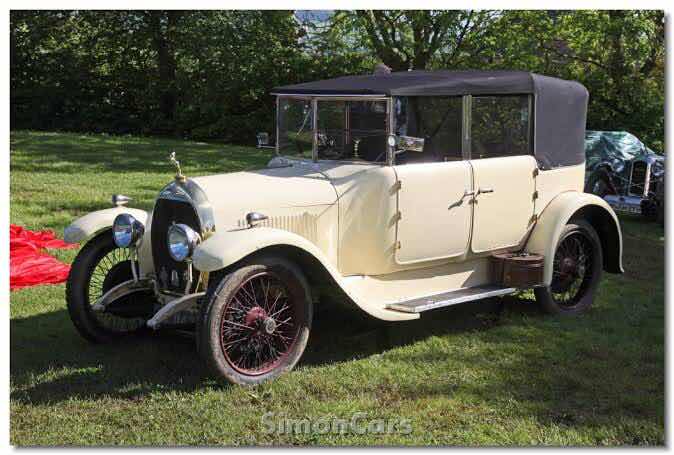
The first postage stamp displays the winning car Hotchkiss in 1933 and the other one shows the Pobeda, which has been converted into a electric car in Estonia and which will be competing for the sixth time and has become the mascot of the rally.


“Pobeda” was first manufactured in 1946 at the Gorky Automobile Plant. The final design of the car was defined by the sketches of the artist Samoilov. The drawings for the automobile were created in the shortest time period.

Originally it was planned to manufacture the car under the name “Rodina” (‘homeland’ in Russian). Joseph Stalin, the stern leader of the Soviet state, when learned of that name,asked only one question: “So how much will the “Rodina” (homeland) sell for?” Thesame day the name of the car was changed, and the future automotive legend received a new name – “Pobeda” (‘victory’ in Russian).

“Pobeda” was the first passenger car with an integrated body. It had no protruding headlights, fenders, running boards. Also, “Pobeda” had an increased glass area. The engine was placed in the front. Combined with an independent front suspension it allowed to make the car lower, making it more stable on the road and more manageable. “Pobeda” was the first car with a trunk.


Hotchkiss were luxury cars made between 1903 and 1955 by the French company Hotchkiss et Cie in Saint-Denis, Paris.The first Hotchkiss car, a 17 CV four-cylinder model, appeared in 1903.With the outbreak of World War I, the factory turned to war production and a subsidiary plant was opened in Coventry, England. Car production resumed in France 1919 with the pre war types AD, AD6, AF and AG. 

During World War I, they produced machine guns and tested them from the factory roof. The 411 was an 11CV model with four-cylinder engine, the 413 a 13CV four and the 615, 617 and 620 were similar six-cylinder types. 

The 1936 - 686, which replaced the 620, was available as the high-performance Grand Sport and 1937 Paris-Nice with twin carburettors and these allowed Hotchkiss to win the Monte Carlo Rally in 1932, 1933, 1934, 1939, 1949 and 1950. The new naming scheme introduced in 1936 consisted of the number of cylinders, followed by the bore of the engine (in millimetres).

The Monte Carlo Rally is a rallying event organised each year by the Automobile Club de Monaco which also organises the Formula One Monaco Grand Prix. From its inception in 1911 by Prince Albert I it was an important means of demonstrating improvements and innovations to automobiles. The Monte Carlo Rally was to start at points all over Europe and converge on Monte Carlo. The rally comprised both driving and then somewhat arbitrary judging based on the elegance of the car, passenger comfort and the condition in which it arrived in the principality. 

Wednesday, October 3, 2018

Fauna of Estonia


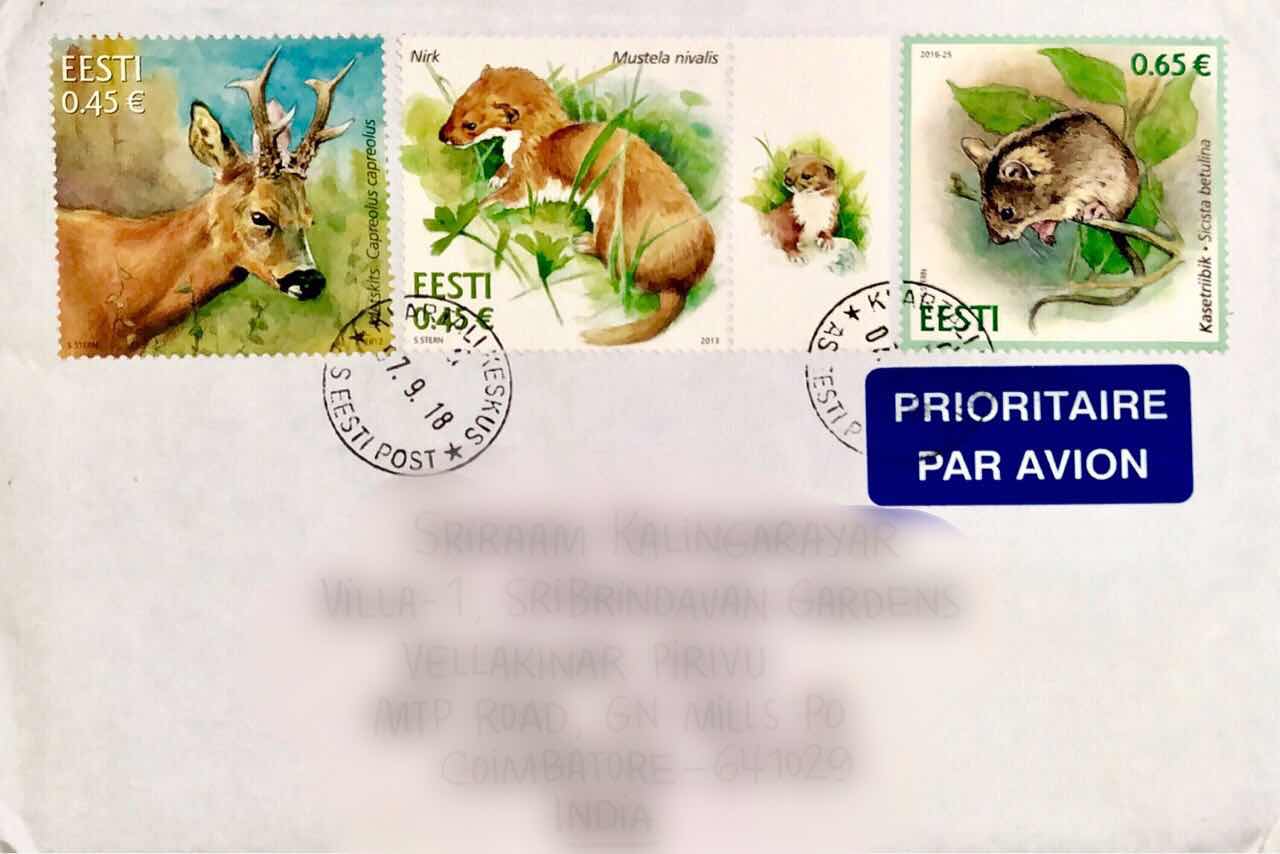
A beautiful cover from Estonia. 

Northern birch mouse 


 The northern birch mouse is a smaller mouse sized rodent belonging to the family of the Dipodidae. Its characteristics are a black stripe on the back and a tail much longer than its body. The northern birch mouse is an omnivore that eats both fruits and seeds as well as insects and caterpillars of butterflies. It hibernates from September to May. When waking up in spring, the animals weigh only about 8 grams, however, by autumn, they store plenty of fat, weighing nearly 15 grams then. They breed once a year and usually 4–6 young are born per litter. The northern birch mice prefer thick and high vegetation areas in forests, meadows, and around old farms as their habitat. They often climb on higher herbaceous plants and bushes. The northern birch mouse occurs in the forest zone from Norway, Denmark, and Austria to Lake Baikal, but they are rarely seen in all those places. In Estonia, the northern birch mouse occurs on the mainland only.
Issue Date: 25.08.2016
Designer: Sandor Stern


Weasel 


 The tail of the weasel, brownish on the back and white on the belly in the summer, is slightly shorter than that of the other small carnivore, the ermine, and the hair at the end of its tail is never black. In the winter, the weasel turns white all over. Weasels live everywhere where they can hide and where there is prey, from sand dunes to grasslands to forests and hills. They are active round the clock. The tracks mostly come in pairs, and the track of the tail is noticeably only seldom. The weasel likes to sometimes stand up and observe the neighbourhood. When disturbed it hisses or trills at a high pitch. It expresses fear by means of sharp yelping. The weasel is so small (body length 15 to 20 cm) that it can follow rodents into their nests. It mainly catches and eats microta and mice, but does not refuse birds and eggs either. In order not to die it has to eat at least every 24 hours. Sometimes it takes over its the barrow of its prey. When disturbed it hisses at a high trill and expresses fear by means of short sharp yelps. Gestation lasts from 34 to 37 days, and the litter usually has four to six young. There could be two litters in one year. The female takes care of the young. In nature it lives three years old, but in artificial conditions it can live up to ten years. It is common everywhere in Estonia, even on small islands
Date of issue :06-06-2013
Designer : Sandor stern 

Roe Deer 


The Roe Deer is a small crevice with a slender body and thin legs, standing about 135 centimetres high and weighing up to 30 kilos. In summer it has reddish brown and in winter greyish hair. The white or dull yellow rump patch is particularly conspicuous in females. Only males have antlers. Their favourite habitats are landscapes where clear areas alternate with groves. In the summer they eat grass but have to do with shrubs, tree or bush shoots and bark, including spruce and pine needles in winter. The young, one to two fawns per one female, are born in May to June. Roebucks live to be seven to eight years old in the wild, goats a little longer. Their most important natural enemies are the wolf and the lynx. In late winter also stray dogs kill animals that have become week over the winter. The roe deer is one of the most important game animals in Estonia, the population of which fluctuates a great deal depending on the severity of the winter, thickness of the snow cover, disease, carnivores' pressure and other factors. 
Date of issue : 16-02-2012
Designer : Sandor stern 

Three animals from Estonia - and all three with the peculiar and common feature of changing their colour / characteristics during winter . 

Thanks Triin for the lovely cover ! 

Friday, August 31, 2018

Birds and trees of Estonia


A nice cover sent by an Indian from Estonia ! 

Estonia is one of the ex- soviet countries close to the northern coast of Europe ! The outer envelope has two stamps - one being the postal horn definitive for 0.10€ and the other stamp is one of the two stamps of Estonia - Romania joint issue on Forest species . The stamps were issued in 2017 and features two forest species - the Spruce and the Roman trees . 

Rowan (Sorbus aucuparia) is a species of deciduous and perennial tree in the Sorbus genus of the rose family. Rowans grow in nearly all of Europe. In Estonia, rowans are common in the edges fields and underbrush and they grow to be 10–15 high and 30–50 thick. Due to its beautiful flowers and fruits, rowans are grown as decorative trees; some of their fruit are edible and healthy; their timber is flexible and strong, and therefore perfect for carpentry. Rowans do not shed their berries in the fall, so they are important sources of food for birds in the winter when it is snowing. The stamp has a face value of 1.40€ 

Wednesday, August 8, 2018

Estonia


A cover from Estonia - the FDC shows a pigeon with a beautiful matching cancellation too ! And the outer envelope has two stamps - the postal horn definitive , and the Estonia - Romania joint issue stamp on forest trees. This stamp - one of the two stamps - shows a Rowan shrub . The Rowan trees are found in the temperate regions of the Northern hemisphere and the berries are rich in organic minerals . 


Another cover - a registered post from Estonia - with the entire set of the birds stamps on it and the postal horn definitive and also the flag of Estonia stamp ! 

The Estonia flag is a tricolour - sinimustvalge - literally meaning “ blue-black-white” . The blue denotes the sky , the black for the soil and centuries of worry , and white for hard work and commitment! It’s a 1.40€ stamp . 
 The capercaillie is a national symbol of Estonia . It is the first bird to arrive here after the ice age and has stayed in Estonia since then. It’s the Estonian bird of the year 2018. 

 The turtle dove is the smallest European dove. Its head is greyish, its throat pink, the wings orange with black spots, the lower part of the abdomen white. The vital feature is a black and white striped spot on the neck. The places where it usually lives are sparse broadleaved forests. The turtle dove's utterance is a low and monotonous gurgling that sounds like the purring of a cat. The ruff turtle dove is the size of the thrush, with a slender body and long tail. The main tone of its plumage is creamy beige with one black spot on the neck. The ruff turtle dove lives in human settlements or close to them. Its song is a quiet "guguu-kuk" which somewhat sounds like the cuckoo. It’s the Estonian bird of the year 2017

The common grooming bird of Estonia, The Great Tit bird is known to everyone by its black strip as well as the black head and a big white blot on the cheeks. It’s the Estonian bird of the year 2016. 

The Grey Partridge (Perdix perdix) is a small bird of the pheasant family who mainly lives in farmland – in fields as well in pasturelands. It passes the winter in groups, often in the vicinity of human settlements. It’s the 2013 bird of the year ! 

Beautiful covers - showing the different birds of Estonia ! Maybe I should collect the entire set from 2002. 

Why is Estonia called Eesti ? It’s the phonetic pronounciatiin of Estonia in Estonian language . The country is one of the fastest growing economies of EU and has a high Human Development Index as per UN ranking . The country gained independence after 1918 and then was occupied by Soviets during WW-2 . It gained independence from USSR after the Singing revolution in 1991. Quite interesting ?!