Showing posts with label World War One. Show all posts

Sunday, May 5, 2019

Krupp - The German Steel Empire


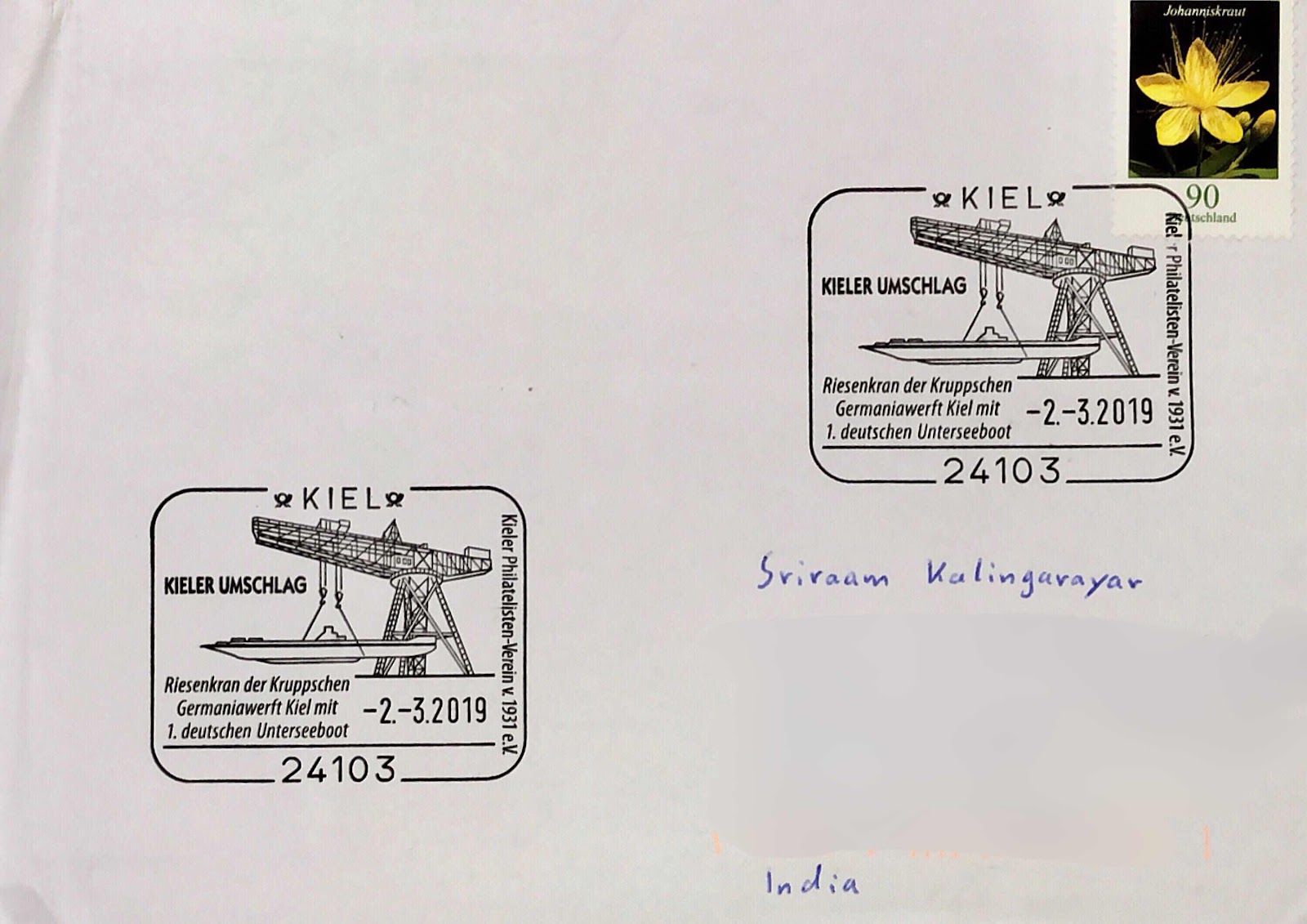
A cover from Germany 🇩🇪 with a very interesting postmark ! 


Friedrich Krupp Germaniawerft (often just called Germaniawerft, "Germania shipyard") was a German shipbuilding company, located in the harbour at Kiel, and one of the largest and most important builders of U-boats for the Kaiserliche Marine in World War I and the Kriegsmarine in World War II. The original company was founded in 1867 but went bankrupt and was bought out by Friedrich Krupp. Krupp was very interested in building warships and in the time before the First World War built a number of battleships for the Kaiserliche Marine, including SMS Posen, SMS Prinzregent Luitpold, SMS Kronprinz, and SMS Sachsen. A total of 84 U-boats were built in the shipyard during the war. After the war it returned to the normal production of yachts and transports.

After the war, the partially ruined shipyard was one of the first facilities dismantled by the victorious Allies. The population of heavily bombed Kiel protested furiously this decision, but to no avail. The site was broken up and not rebuilt. In the late 1960s, the grounds were purchased by Howaldtswerke-Deutsche Werft as a submarine-building shipyard. As of 2015, submarines are being built at the site.

The Krupp family - a prominent 400-year-old German dynasty from Essen, is famous for their production of steel, artillery, ammunition and other armaments. The family business, known as Friedrich Krupp AG, was the largest company in Europe at the beginning of the 20th century, and was important to weapons development and production in both world wars. One of the most powerful dynasties in European history, Krupp flourished for 400 years as the premier weapons manufacturer of Germany. From the Thirty Years' War until the end of the Second World War, it produced battleships, U-boats, tanks, howitzers, guns, utilities, and hundreds of other commodities.

Thanks Dustin for this beautiful cover :) 

Monday, April 15, 2019

Fairbanks - the Alaskan Frontier


A cover from Alaska , USA 

Fairbanks is the largest city in the Interior region of Alaska. 2016 estimates put the population of the city proper at 32,751, and the population of the Fairbanks North Star Borough at 97,121,making it the second most populous metropolitan area in Alaska (after Anchorage). The Metropolitan Statistical Areaencompasses all of the Fairbanks North Star Borough and is the northernmost Metropolitan Statistical Area in the United States, located 196 driving miles (or 140 air miles) south of the Arctic Circle.

The cover has been posted at Alaskan Frontier postoffice - which is just above the Arctic circle 

Issue date- 27/7/2018

This 2018 issuance honors the millions of Americans, who participated in World War I, the seminal conflict of the twentieth century. The United States, despite remaining neutral until 1917 and not engaging in major combat until 1918, helped end the four-year global conflict (1914-1918) and emerged from it as a major world power.

The stamp art features a close-up of a member of the American Expeditionary Force holding the U.S. flag. Barbed wire can be seen in the background, as well as an airplane in flight and smoke rising up from the battlefield. 

The American Expeditionary Force, which ultimately grew to nearly five million troops, did not see major action until the spring of 1918. Then in six months of intense combat, some 53,000 Americans died on the battlefield, and American troops played an indispensable role in turning the tide of war in favor of the Allies.

Mark Stutzman painted the artwork in airbrush on illustration board, a technique that evokes the propaganda posters used during World War I. Art director Greg Breeding designed the issuance.

Issue date: 25/05/2015

The Medal of Honor is USA’s most prestigious military decoration. It is awarded by the President of the United States on behalf of Congress to members of the armed services who distinguish themselves through “conspicuous gallantry and intrepidity at the risk of life above and beyond the call of duty” while engaged in action against an enemy of the United States.


Monday, March 18, 2019

100 years ... German republic and German AirMail


A cover from Germany 🇩🇪 with stamps and postmark depicting important events immediately after World War One.


With the end of the First World War and the start of the November Revolution, Chancellor Max of Baden announced the abdication of the German Emperor Wilhelm II on 9 November 1918. He also appointed Friedrich Ebert as his own successor as Chancellor. 

In October 1918, the constitution of the German Empire was reformed to give more powers to the elected parliament. On 29 October, rebellion broke out in Kiel among sailors. There, sailors, soldiers, and workers began electing Workers' and Soldiers' Councils (Arbeiter und Soldatenräte) modeled after the Soviets of the Russian Revolution of 1917. The revolution spread throughout Germany, and participants seized military and civil powers in individual cities. The power takeover was achieved everywhere without loss of life.

The elections for the National Assembly on 19 January 1919 were the first elections in Germany after the introduction of women's suffrage.The legal voting age had been lowered from 25 to 20 years. Together, these changes raised the number of eligible voters by around 20 million. The turnout rate was 83%, a slightly lower percentage than in the last Reichstag elections in 1912, but a much greater absolute turnout due to the expanded suffrage. Among women the turnout was 90%.


100th anniversary of Women Suffrage 
Issue - January 2019

The Postmark : 

The first regular national airmail connections under German administration were established at the end of World War I at the eastern front in Russia and the Baltic provinces. The history of German civil airmail started on February 5, 1919. Airplanes took off twice a day from Berlin-Johannisthal to transport postal consignments—initially newspapers but letters from the second day—from the Berlin to the location of the convention of the constituent Weimar National Assembly in Weimar. At first this airmail facility could only be utilised by delegates, who had moved to Thuringia's capital at that time, to avoid the revolutionary situation in Berlin. A few months later this airmail route was made available to the public. 

In the following years, airmail connections quickly developed in Germany, as well as in the whole of western Europe and the USA.


Thursday, March 7, 2019

Reintegration Of Medimurje with Croatia


A postal stationary from Croatia 🇭🇷 

A prepaid postcard was issued in January 2019 commomerating the 100th anniversary of the reintegration Of Medimurje with The Kimgdom Of SHS. 

Međimurje County is a triangle-shaped county in the northernmost part of Croatia, roughly corresponding to the historical and geographical region of Međimurje. Despite being the smallest Croatian county by size, it is the most densely populated one (not including the City of Zagreb). The county seat is Čakovec, which is also the largest city of the county.

On 9 January 1919, an assembly of local deputies decided to secede Međimurje from Hungary and the decision was made in the presence of 10,000 people who gathered in the Franciscan Square in Čakovec on that occasion.

The region joined the Kingdom of Serbs, Croats and Slovenes ( kingdom of SHS ) which was later called Yugoslavia. Upon the adoption of the resolution on secession, the Croatian language was introduced in schools and the public life in the area mainly populated by Croats.

Kingdom of SHS 

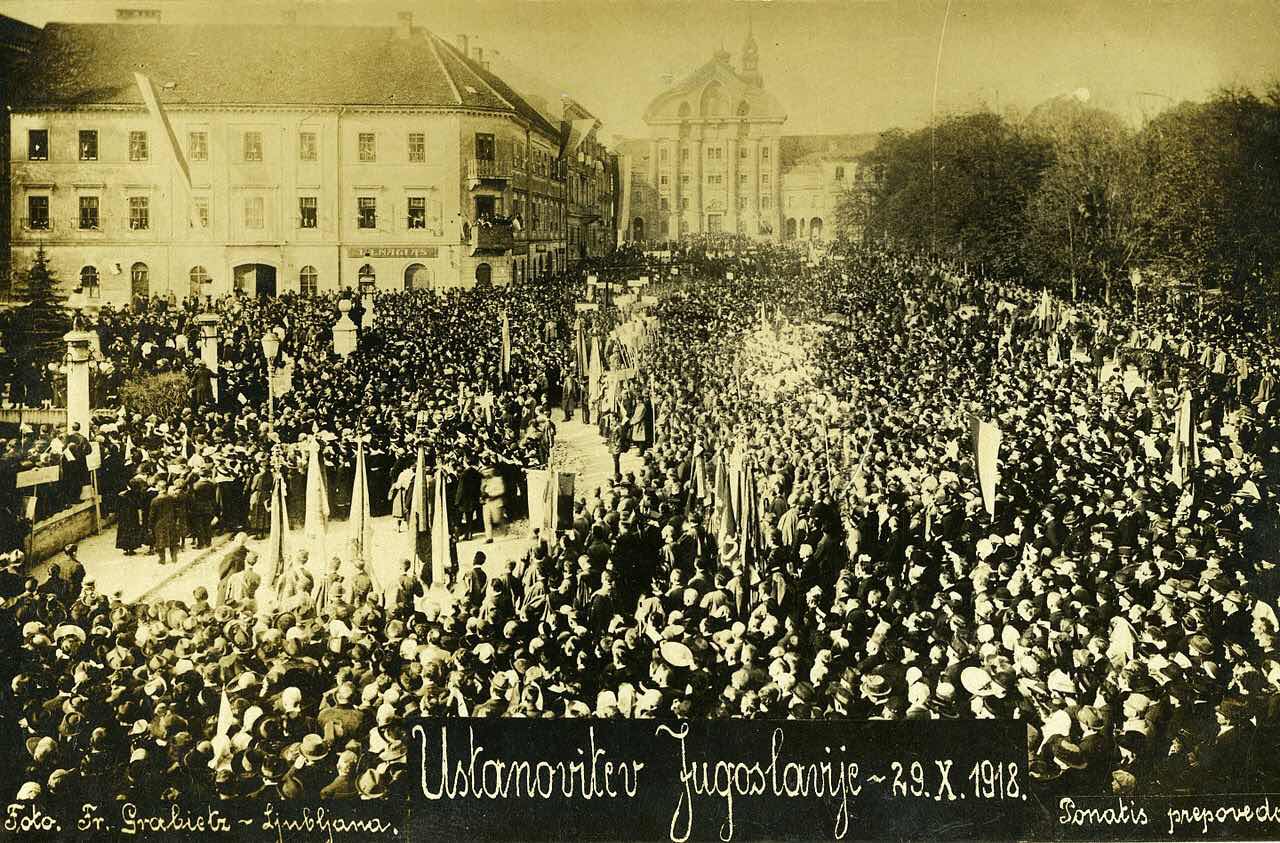
The State of Slovenes, Croats and Serbs was a political entity that was constituted in October 1918, at the end of World War I, by Slovenes, Croats and Serbs resident in what were the southernmost parts of the Austro-Hungarian Empire. Although internationally unrecognized, this was the first incarnation of a Yugoslav state founded on the Pan-Slavic ideology. Thirty-three days after it was proclaimed, the State joined the Kingdom of Serbia to form the Kingdom of Serbs, Croats and Slovenes.


The postcard has been posted at Cakovec! The preprinted stamp shows the map of Medimurje county during 1919 when it seceded to kingdom of SHS .. and the stamps of Hungary post overprinted with SHS can be seen printed on the left side of the postcard. The postcard has been uprated for international postage with another Croatian stamp - commomerating the 100 th anniversary of the first stamp of Croatia. 


Thanks Tom for this special postcard - and for finding a postcard that tells a World War One history from Croatia ! 

Tuesday, January 22, 2019

Armistice in France


Another Armistice cover - from France ! - from where the Armistice was declared ! 


The Armistice of 11 November 1918 was the armistice that ended fighting on land, sea and air in World War I between the Allies and their opponent, Germany. Previous armistices had been agreed with Bulgaria, the Ottoman Empireand the Austro-Hungarian Empire. 

Also known as the Armistice of Compiègne from the place where it was signed at 5:45 a.m. by the French Marshal Foch, it came into force at 11:11 a.m. Paris time on 11 November 1918 ("the eleventh minute of the eleventh hour of the eleventh day of the eleventh month") and marked a victory for the Allies and a defeat for Germany, although not formally a surrender.


The actual terms, largely written by the Allied Supreme Commander, Marshal Ferdinand Foch, included the cessation of hostilities, the withdrawal of German forces to behind the Rhine, Allied occupation of the Rhineland and bridgeheads further east, the preservation of infrastructure, the surrender of aircraft, warships, and military material, the release of Allied prisoners of war and interned civilians, eventual reparations, no release of German prisoners and no relaxation of the naval blockade of Germany.

There was no question of negotiation. The Germans were able to correct a few impossible demands. 


The Armistice was the result of a hurried and desperate process. The German delegation headed by Matthias Erzberger crossed the front line in five cars and was escorted for ten hours across the devastated war zone of Northern France, arriving on the morning of 8 November. They were then taken to the secret destination aboard Ferdinand Foch's private train parked in a railway siding in the Forest of Compiègne.

The forest is notable as the site of the Armistice between the Allies and Germany which ended World War I on 11 November 1918, as well as the Armistice of 22 June 1940 after the Battle of France in World War II. During World War II, a second treaty was signed in the forest, this time arranging an armistice between France and Nazi Germany(22 June 1940). With an unmistakable desire to humiliate his defeated enemy, German dictator Adolf Hitler gave orders that the surrender should be received in exactly the same spot, even the same railway car, where the Germans had surrendered in 1918.

 A famous memorial tablet placed at the precise location of the cease-fire signing reads (in French), Here on the eleventh of November 1918 succumbed the criminal pride of the German Reich... vanquished by the free peoples which it tried to enslave. The original tablet was destroyed by the Nazis, but a new one was emplaced after the war.

For bringing the German delegation to the 1918 meeting, the French had assembled the train with a special saloon car which had once belonged to Napoleon III. The car was decorated with old Imperial emblems, redolent of past glories and mutely confirming the resurgence of French power after its defeat in the Franco-Prussian War in 1870. The two sides then met in a newer railcar, supplied by Compagnie Internationale des Wagons-Lits, to sign the armistice. 

After the fall of France in World War Two, this same railway carriage was specifically used by the Germans for the armistice of 1940; it was remanded to Germany where it was eventually destroyed by SS troops in Crawinkel, Thuringia, in 1945, and the remains were buried. In 1950, a faithful replica of this original railcar was installed at the site. Decades later, some vestiges of the original car were discovered in Germany and returned to France: the pieces were added to the memorial display in 1995.

Wednesday, January 9, 2019

RMS Lusitania- the ship with short life and a long history


A cover from Ireland with a minisheet showing an important event in World War One! 


RMS Lusitania was a British ocean liner and briefly the world's largest passenger ship. The ship was sunk on 7 May 1915 by a German U-boat 11 mi (18 km) off the southern coast of Ireland. The sinking presaged the United States declaration of war on Germany in 1917.


Lusitania was a holder of the Blue Ribandappellation for the fastest Atlantic crossing, and was briefly the world's largest passenger ship until the completion of her sister ship Mauretania, three months later. The Cunard Linelaunched Lusitania in 1906, at a time of fierce competition for the North Atlantic trade. She sank on her 202nd trans-Atlantic crossing.

Both Lusitania and Mauretania were fitted with revolutionary new turbine engines that enabled them to maintain a service speed of 25 knots(46 km/h; 29 mph). Germany was the main contender for the North Atlantic trade and Germany also relied upon her northern sea route for her food supplies since her other borders were at warfare ! 

The Royal Navy had blockaded Germany at the start of the First World War. The UK declared the entire North Sea a war zone in the autumn of 1914, and mined the approaches; in the spring of 1915 all food imports for Germany were declared contraband. When RMS Lusitania left New York for Britain on 1 May 1915, German submarine warfare was intensifying in the Atlantic. Germany had declared the seas around the United Kingdom a war zone, and the German embassy in the United States had placed newspaper advertisements warning people of the dangers of sailing on Lusitania.

On the afternoon of 7 May, a German U-boat torpedoed Lusitania 11 mi (18 km) off the southern coast of Ireland and inside the declared war zone. A second, unexplained, internal explosion, probably that of munitions she was carrying, sent her to the seabed in 18 minutes, with the deaths of 1,198 passengers and crew.

The Germans justified treating Lusitania as a naval vessel because she was carrying hundreds of tons of war munitions, therefore making her a legitimate military target, and argued that British merchant ships had violated the Cruiser Rules from the very beginning of the war.

The sinking caused a storm of protest in the United States because 128 American citizens were among the dead. The sinking helped shift public opinion in the United States against Germany and was a factor in the United States' declaration of war nearly two years later.

Thanks Fabio for this cover with these stamps ! 

Armistice from Serbia


Cover from Serbia with a minisheet honouring doctor’s who served in WW1 and others stamps and minisheet ! 

There is a lot of information in these stamps and I have been putting this cover away ( which I shouldn’t be doing ) - but being the lazy me - I am. 

So I thought I will upload the cover here and write up about it some day ! 

If anyone is willing to contribute , I would be super happy !! 

Tuesday, December 18, 2018

Armistice in Portugal


A cover from Portugal with a stamp honouring the soldiers of Ww1 on the centenary of Armistice ! 


  • 10.08.2018
  • Atelier Design&etc / Hélder Soares

Portugal remained neutral during the initial years of ww1. But there was growing hostility towards Germany , because Germany blocked ships going to UK by using its u- boats . UK was the major market for Portuguese products . So ultimately Portugal joined ww1 in March 1916 to safeguard its commercial interests and also its African colonies from German and British occupation . Portugal suffered heavy casualties in the war. The war cost Portugal 8,145 dead, 13,751 wounded and 12,318 prisoners or missing. At sea, 96 Portuguese ships were sunk (100,193 tons) and 5 Portuguese ships damaged (7,485 tons) by German submarines. Portugal heaved a sigh of relief when the war ended on 11-11-1918 .

“The Past is brought to life on these stamps, forging a relationship with us, who contemplate it from the perspective of the Present. After all, this relationship marks the con uence of the Truth of what happened with theSense that time has given it. And it is this interweaving of what it has given us to Learn that we manage to retrieve elements for forging our Futureand rea rm it as a Project in progress.

It means honouring the memory of Portugal’s involvement in the Great War and doing justice to the tenacity and altruism of those who marchedbeneath our ag. It means going beyond a mere abstract commemoration of a particular day. It means giving weight and value to the Transmission of this memory, lest we lose ourselves altogether.

So listen to the lesson, perhaps the greatest lesson of all, that this Centenary has to teach us: nothing is a given; the limits of what makes us human are vulnerable; civilisation is a matter of uncertain, faltering triumphs; fragile in essence. And let us reassert the value of Responsibility.

Long reign a time of wine and bread and owers. A time when the earthis made fertile with Hope.”

- José Alberto de Azeredo Lopes 
   Ministry of National Defence

Friday, December 14, 2018

The Man who proclaimed Germany - a Republic


Another cover from Dustin , Germany with a special cancellation ! 

The cancellation shows the portrait of the man who proclaimed Germany a Reupblic on 9-11-1918 ( exactly 100 years before the date of cancellation ) - Philipp Heinrich Scheidemann . 


The German Revolution or November Revolution was a civil conflict in the German Empire at the end of the First World War that resulted in the replacement of the German federalconstitutional monarchy with a democratic parliamentary republic that later became known as the Weimar Republic. The causes of the revolution were the extreme burdens suffered by the population during the four years of war, the strong impact of the defeat on the German Empire and the social tensions between the general population and the elite of aristocrats and bourgeoisie who held power and had just lost the war.

Philipp Heinrich Scheidemann (26 July 1865 – 29 November 1939) was a German politician of the Social Democratic Party of Germany (SPD). On 9 November 1918, in the midst of the German Revolution of 1918–1919, he proclaimed Germany a republic. In 1883, he joined the Social Democratic Party of Germany (the SPD) and became a union member. At the time, the German Anti-Socialist Laws were still in force and the SPD was essentially an underground organisation. In the German federal election of 1903, Scheidemann was elected from the SPD to the German Reichstag for a constituency in Solingen; he retained this seat until 1918.

On 9 November 1918, Chancellor Max von Baden unilaterally announced the abdication of the German Emperor Wilhelm II and the renunciation of the hereditary rights to the throne of Crown Prince Wilhelm. Maximilian von Baden resigned and unconstitutionally designated Ebert his successor as "Imperial chancellor" and "Minister-President" of Prussia. Fredrich Ebert was the leader of the SPD. A huge crowd assembled outside, and there were calls for a speech. Ebert refused to speak to the crowd, but Scheidemann stood up and rushed to a window facing it. According to Scheidemann's own recollection, someone told him along the way that the Spartacist (communist) leader Karl Liebknechtintended to declare Germany a Soviet Republic. Scheidemann then made a spontaneous speech that closed with these words:

The old and rotten, the monarchy has collapsed. The new may live. Long live the German Republic!


The Spartacists were inspired by Marxist communism and they were against any form of power to the upper class bourgeoise of the German Empire . Ebert and Scheidemann formed a group in SPD who were not averse to the upper class , but wanted a compromise and peaceful Armistice with power to the working class. The revolutionary group within the SPD formed the Spartacists. 

Ebert and Scheidemann’s plans were to preserve the existing structure of government under a Chancellor Ebert, restore calm and deal with the pressing issue of the armistice with the Allied powers. Yet the revolution seemed likely to force the SPD to share power with those on the far left: the Spartacists. Ebert became joint Chairman with Hugo Haase of the USPD. 

Thus Germany became a de factor republic with the proclamation by Philipp Heinrich Scheidemann on 9th November 1918  and became a de jure republic when the position of the President Of Germany was created in February 1919. The National Assembly was covered in Weimar in August 1919 where a new constitution for Germany was written and adopted on 11 August 1919. In its fourteen years, the Weimar Republic faced numerous problems, including hyperinflation, political extremism (with paramilitaries—both left- and right-wing) as well as contentious relationships with the victors of the First World War. Resentment in Germany towards the Treaty of Versailles was strong especially on the political right where there was great anger towards those who had signed the Treaty and submitted to fulfill the terms of it. The Weimar Republic fulfilled most of the requirements of the Treaty of Versailles although it never completely met its disarmament requirements and eventually paid only a small portion of the war reparations. 

Though the Armistice ended the word war one , the Germans remained wounded and hurt ! 

Thursday, December 13, 2018

Kiel Mutiny


A cover from Germany with a very interesting cancellation ! 

The cancellation honours 100 years of the Kiel Mutiny! Germany has not issued any stamps for the centenary of ww1, but this year it has come out with few cancellations for the event . 

Kiel Mutiny 

The Kiel mutiny was a major revolt by sailors of the German High Seas Fleet on 3 November 1918. The revolt triggered the German revolution which was to sweep aside the monarchy within a few days. It ultimately led to the end of the German Empire and to the establishment of the Weimar Republic.

The Heligoland Bight, also known as Helgoland Bight, is a bay which forms the southern part of the German Bight, itself a bay of the North Sea, located at the mouth of the Elbe river. The Heligoland Bight extends from the mouth of the River Elbe to the islands of Heligoland and lies between the East Frisian island of Wangeroogeand the North Frisian peninsula of Eiderstedt. Named after Heligoland, it was the location of World War I naval battles in 1914 and 1917.

The sailors' revolt started on the Schillig Roads off Wilhelmshaven, where the German fleet had anchored in expectation of a planned battle. During the night from 28 to 30 October 1918 some crews refused to obey orders. Sailors on board three ships from the Third Navy Squadron refused to weigh anchor. Part of the crew on SMS Thüringen and SMS Helgoland, two battleships from the First Navy Squadron, committed outright mutiny and sabotage.

However, when, a day later, some torpedo boats pointed their cannons at these ships, the mutineers gave up and were led away without any resistance. Nevertheless, the naval command had to drop its plans as it was felt that the crew's loyalty could no longer be relied upon. The Third Navy Squadron was ordered back to Kiel.The squadron commander, Vizeadmiral Hugo Kraft, exercised a maneuver with his battleships in the Heligoland Bight. When it "functioned perfectly (tadellos funktionierte)" he believed he was master of his crews again. While moving through the Kiel Canal he had 47 sailors from the Markgraf, who were seen as the ringleaders, imprisoned. In Holtenau (end of the canal in Kiel) they were brought to the Arrestanstalt (the military prison in Kiel) and to Fort Herwarth in the north of Kiel.


The sailors and stokers were now pulling out all the stops to prevent the fleet from setting sail again and to achieve the release of their comrades. Some 250 met in the evening of 1 November in the Union House in Kiel. Delegations sent to their officers requesting the mutineers' release were not heard. The sailors were now looking for closer ties to the unions, the Independent Social Democratic Party of Germany (USPD) and the SPD. Thereupon the Union House was closed by police, leading to an even larger joint open-air meeting on 2 November, at the large drill ground (Großer Exerzierplatz).

Led by the sailor Karl Artelt, who worked in the repair ship yard for torpedo boats in Kiel-Wik and by the mobilized shipyard worker Lothar Popp, both USPD members, the sailors called for a large meeting the following day at the same place. 

Karl Artelt , with his comrades 

This call was heeded by several thousand people on the afternoon of 3 November with workers' representatives also being present. The slogan "Frieden und Brot" (peace and bread) was raised showing that the sailors and workers demanded not only the release of the imprisoned but also the end of the war and the improvement of food provisions. Eventually the people supported Artelt's call to free the prisoners and they moved in the direction of the military prison.

Sublieutenant Steinhäuser, who had orders to stop the demonstrators, ordered his patrol to give warning shots and then to shoot directly into the demonstrators. Seven men were killed and 29 were seriously injured. Some demonstrators also opened fire. Steinhäuser was severely injured by rifle-butt blows and shots, but contrary to later statements, he was not killed. After this incident, commonly viewed as the starting point of the German revolution, the demonstrators dispersed and the patrol withdrew.

The Kiel Mutiny spread all over Germany and paved way for the German revolution of 1918. In a way , Kiel Mutiny was the first step towards Armistice on 11 November 1918. 

Thanks Dustin for the super cover ! 

Tuesday, December 4, 2018

Armistice in Poland


An Armistice cover from Poland ! 

While Poland did not exist as an independent state during World War I, its geographical position between the fighting powers meant that much fighting and terrific human and material losses occurred on the Polish lands between 1914 and 1918.


When World War I started, Polish territory was split during the partitions between Austria-Hungary, the German Empire and the Russian Empire, and became the scene of many operations of the Eastern Front of World War I. In the aftermath of the war, following the collapse of the Russian, German and Austro-Hungarian Empires, Poland became an independent republic.

Much of the heavy fighting on the war's Eastern Front took place on the territory of the former Polish state. In 1914 Russian forces advanced very close to Kraków before being beaten back. The next spring, heavy fighting occurred around Gorlice and Przemyśl, to the east of Kraków in Galicia. In 1915 Polish territories were looted and abandoned by the retreating Imperial Russian army, trying to emulate the scorched earth policy of 1812 ; the Russians also evicted and deported hundreds of thousands of its inhabitants suspected of collaborating with the enemy. By the end of 1915, the Germans had occupied the entire Russian sector, including Warsaw. In 1916 another Russian offensive in Galicia exacerbated the already desperate situation of civilians in the war zone; about 1 million Polish refugees fled eastward behind Russian lines during the war. Although the Russian offensive of 1916 caught the Germans and Austrians by surprise, poor communications and logistics prevented the Russians from taking full advantage of their situation.


A total of 2 million Polish troops fought with the armies of the three occupying powers, 450,000 died and close to one million were wounded. Several hundred thousand Polish civilians were moved to labor camps in Germany, and 800,000 were deported by the Tsarist forces to the East. The scorched-earth retreat strategies of both sides left much of the war zone uninhabitable. Total deaths from 1914–18, military and civilian, within the 1919–1939 borders, were estimated at 1,128,000.

In 1917 two separate events decisively changed the character of the war and set it on a course toward the rebirth of Poland. The United States entered the conflict on the Allied side, while a process of revolutionary upheaval in Russia weakened her and then removed the Russians from the Eastern Front, finally bringing the Bolsheviks to power in that country. After the last Russian advance into Galicia failed in mid-1917, the Germans went on the offensive again; the army of revolutionary Russia ceased to be a factor, and Russia was forced to sign the Treaty of Brest-Litovsk in which she ceded all formerly Polish lands to the Central Powers.


The defection of Russia from the Allied coalition gave free rein to the calls of Woodrow Wilson, the American president, to transform the war into a crusade to spread democracy and liberate the Poles and other peoples from the suzerainty of the Central Powers. The thirteenth of his Fourteen Points adopted the resurrection of Poland as one of the main aims of World War I. Polish opinion crystallized in support of the Allied cause.


Józef Piłsudski became a popular hero when Berlin jailed him for insubordination. The Allies broke the resistance of the Central Powers by autumn 1918, as the Habsburg monarchy disintegrated and the German imperial government collapsed. In October 1918, Polish authorities took over Galicia and Cieszyn Silesia. In November 1918, Piłsudski was released from internment in Germany by the revolutionaries and returned to Warsaw. Upon his arrival, on November 11, 1918 the Regency Council of the Kingdom of Poland ceded all responsibilities to him and Piłsudski took control over the newly created state as its provisional Chief of State. Soon all the local governments that had been created in the last months of the war pledged allegiance to the central government in Warsaw. Independent Poland, which had been absent from the map of Europe for 123 years, was reborn.

Thanks Wojtek for this beautiful cover ! Love the cancellation too - showing a poppy flower - the symbol of World War One ! 


Friday, November 23, 2018

The End of the Great War in UK


A cover from UK with the 2018 stamps on the centenary of word war 

These stamps are part of the 6 stamps issued in 2018 honouring the World War One ! 


100 POPPIES , ZAFER AND BARBARA BARAN


The poppy has been one of the enduring symbols of the First World War and has come to be associated with remembrance. To mark the centenary of the end of the war, Zafer and Barbara Baran photographed one hundred poppy flowers, layering the images together to create 100 Poppies. Each of the poppies was freshly cut and carefully lit before being photographed, to capture the flower’s delicate luminosity. In the final artwork, the light gently filters through the overlapping petals, giving this composite image a ghostly, fleeting appearance and suggesting movement.

‘ANTHEM FOR DOOMED YOUTH’, WILFRED OWEN


In ‘Anthem for Doomed Youth’, British Army officer and poet Wilfred Owen mourns the waste of young lives, cut short by wailing shells and the rattle of rifle fire. Killed in action in 1918, a week before the armistice, Owen has become one of Britain’s most celebrated war poets. In this woodblock print, illustrator Andrew Davidson has hand-carved the opening lines of Owen’s poem. Using an illuminated letter style that evokes the shattered treescapes of war artist Paul Nash, the design reflects the rawness and power of Owen’s words.

SECOND LIEUTENANT WALTER TULL


Second Lieutenant Walter Tull was born in Folkestone in 1888 and orphaned after the death of his English mother and his Barbadian father. He became known as a professional footballer. After war broke out, he served in the Footballers’ Battalion of the Middlesex Regiment and fought on the Somme. Commissioned in May 1917, Tull became the first mixed-race Army officer to command troops in a regular unit. After fighting in Italy, he returned to the Western Front. On 25 March 1918, he was killed in action. Having no known grave, Tull is commemorated on the Arras Memorial.


The postmark is that of Victorian Cross - VC for valour- a very appropriate postmark for the stamps . I understand that the postmark is a temporary pictorial cancellation that is available in the hand stamping centres across UK. 


The Victoria Cross (VC) is the highest and most prestigious award of the British honours system. It is awarded for gallantry "in the presence of the enemy" to members of the British Armed Forces. It may be awarded posthumously. Since the first awards were presented by Queen Victoria in 1857, two thirds of all awards have been personally presented by the British monarch. These investitures are usually held at Buckingham Palace. 628 awards were given to men during the First World War. 

Thanks Wolfgang for this beautiful cover and the matching cancellations on the stamps ! 

Armistice in Australia


Armistice signed - covers from Australia !

Thanks to two good friends , I got two covers ;) 


The Centenary of WWI: 1918 stamp issue, released on 2 October 2018 and designed by Lisa Christensen of Three Branches Design, charts some of the major events and themes from this final year of the war, as well as a key figure. Towards the final years, fewer men were enlisting in the army voluntarily, and conscription was rejected by voting for the second time in Australia. 

John Monash takes command 


The end in sight - Last 100 days 


The guns fall silent - Armistice declared


Homecoming - Return Home 

 
The Human cost - Honouring the Fallen 


The five stamps mark the end of the five part series of Australian stamps honouring the centenary of World War One ! 

gives excellent material to read about the stamps. What I write here would be only a repetition , and I will save you from the agony ! 

Thanks Irene and Tasha for these covers ! Wishing you both a merry Christmas :)